Business Tips
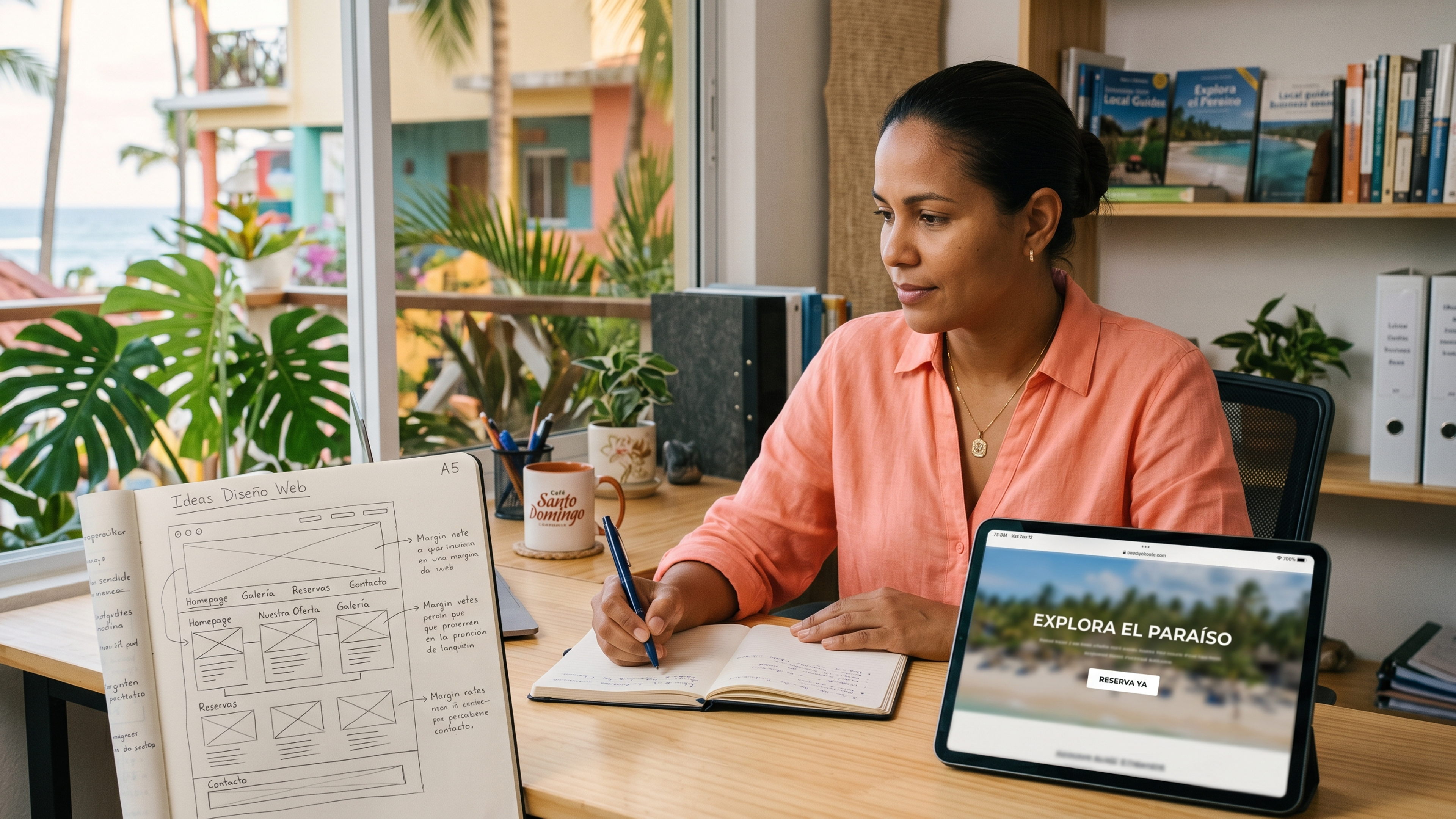
One of the most common questions we get from Dominican business owners is also one of the most expensive to get wrong: "Do I need a full website, or is a landing page enough?"
It is a fair question, and the honest answer is that it depends entirely on what your business actually needs to accomplish. A landing page and a website are not different sizes of the same thing — like a small coffee versus a large coffee. They are different tools that do different jobs. Choosing the wrong one wastes money in both directions: pay for a full website when a landing page would convert better, and you have overspent on pages you do not need; pay for a landing page when your business needs a full website, and you have built something that cannot do the job, forcing a more expensive rebuild within months.
This guide exists to help you make that decision correctly the first time. By the end, you will know which one your business needs, why, and roughly what it should cost.
At DR Web Studio, a landing page is $400 and a full business website is $950. That price difference is real, and it is tempting to choose the cheaper option by default. But the right choice is not about which is cheaper — it is about which one actually does the job your business needs done. Sometimes the $400 option is the smart, correct choice. Sometimes it is a false economy that costs you more in the long run. Let's figure out which situation you are in.
A landing page is a single web page built to accomplish one specific goal. It has one focus, one message, and one primary call to action. There is no navigation menu pulling visitors in different directions, no "About Us" page, no blog, no multi-section exploration. A visitor lands on the page, encounters a single clear offer, and is guided toward a single action: book this, call this number, fill out this form, buy this ticket.
The power of a landing page comes precisely from this focus. Because the page does not offer the visitor multiple paths, it does not let them wander or get distracted. Research consistently shows that focused landing pages convert dramatically better than general pages for specific, single-goal campaigns. For small business service sites, a focused landing page tied to a single offer can convert at 8–10% or higher, compared to roughly 3% on a general contact form. Removing distractions and competing options is itself one of the most reliable ways to increase conversion — minimizing distractions on a page can boost conversions meaningfully.
A landing page answers exactly one question for the visitor: "Should I take this one specific action, yes or no?" Everything on the page exists to push them toward yes.
A website is a multi-page digital presence that represents your entire business. It has a homepage, service or product pages, an about page, a contact page, often a blog, and frequently a portfolio or gallery. It is navigable — visitors can explore, move between sections, and follow their own path through your content depending on what they are looking for.
A website's job is broader than conversion on a single offer. It builds your brand and credibility, ranks in Google across many different search terms (each page can target different keywords), serves visitors at every stage of their journey from first curiosity to ready-to-buy, houses the depth of content that establishes you as a real, trustworthy business, and supports the full range of things a customer might want to know before choosing you.
Where a landing page asks "yes or no to this one thing," a website says "here is everything we are, explore what matters to you." It is the difference between a single, sharp sales pitch and a complete storefront.
The simplest way to understand the choice: a landing page is a focused conversion tool; a website is a complete business presence.
If your need is to convert a specific audience toward a specific action — sign-ups for one event, bookings for one promotional package, leads from one advertising campaign — the focus of a landing page is the right tool. If your need is to establish your business online comprehensively, rank in Google for the range of things you offer, and serve customers at every stage of their decision, the breadth of a website is what you need.
Most businesses, over time, need both. But the question of which to build first — or which to build now — depends on where your business is and what it most needs to accomplish today.
A landing page ($400) is the smart, correct choice in these situations.
You are running a focused advertising campaign. If you are spending money on Google Ads, Facebook, or Instagram ads to drive a specific audience to a specific offer, sending that paid traffic to a landing page rather than a full website will almost always convert better. The single focus matches the single intent of the ad. A tourist who clicks an ad for "Saona Island Tour — Book Now" should land on a page about exactly that, with a booking button — not on a homepage where they have to navigate to find it.
You have one specific offer to promote. A single tour package, one event, one seasonal promotion, one product launch. When the goal is one clear conversion on one clear offer, a landing page is purpose-built for it.
You are testing a business idea. If you are launching something new and want to validate demand before investing in a full website, a landing page is the lean, low-cost way to test whether people will respond. Put up a landing page, drive some traffic to it, and see if it converts. If it does, you have evidence to justify building out the full website.
You need something live quickly and inexpensively. A landing page can be built and launched faster and at lower cost than a full website. If you have an immediate, time-bound need — a promotion launching next week, an event next month — a landing page gets you live in time.
You are a solo provider with a single service. A freelance photographer who only shoots weddings, a consultant who offers one specific service, a coach with one program — a business with genuinely one thing to sell can sometimes be served completely by a single, well-built page.
In all these cases, the $400 landing page is not the "budget compromise." It is the right tool. Spending $950 on a full website here would mean paying for pages and capabilities that do not serve the actual goal.
A full website ($950) is the right choice — and a landing page would be a false economy — in these situations.
You offer multiple services or products. A dive center that offers beginner courses, certifications, reef dives, shark dives, and equipment rental cannot communicate all of that on a single landing page. Each offering deserves its own page that can rank in Google for its own search terms and serve visitors looking for that specific thing. A tour operator with a dozen excursions, a restaurant with a menu and events and reservations, a wedding photographer with multiple packages and a portfolio — these businesses need the breadth of a website.
You want to rank in Google across many search terms. This is one of the most important distinctions. A single landing page can realistically rank for a small cluster of related keywords. A full website, with a separate page for each service and a blog producing ongoing content, can rank for dozens or hundreds of search terms. If organic Google traffic is part of your growth strategy — and for most Dominican tourism businesses, it should be — you need the multi-page structure that only a website provides. This is why our articles on how long SEO takes and bilingual SEO assume a full website foundation.
Your customers research before buying. For higher-consideration purchases — a destination wedding, a multi-day tour package, a venue booking, a significant service — customers want to explore. They read multiple pages, check the about section to see who they are dealing with, review testimonials, browse a portfolio, and read FAQs before they commit. A single landing page cannot hold that depth. These customers need a website they can explore to build the trust that precedes a significant booking.
You need to build long-term brand credibility. A professional website signals that you are an established, serious business. For businesses competing on trust — and in the Dominican tourism market, where international customers are choosing businesses they have never heard of, trust is the primary conversion barrier — a comprehensive website does credibility work that a single page cannot.
You serve customers in both English and Spanish. A proper bilingual website with separate indexed pages for each language captures both the international tourist market and the Spanish-speaking visitor market across all your services. This breadth of bilingual coverage is a website-scale undertaking.
In these situations, choosing the $400 landing page to save money is a false economy. The landing page will not be able to do what the business needs, and within months you will be paying again to build the full website you needed from the start — having spent $400 on something you have to replace rather than $950 on something that does the job.
If you want the fastest possible way to decide, ask yourself this:
"Does my business have one thing to sell to one audience through one action — or multiple things to sell to people at different stages of deciding?"
If it is genuinely one thing, one audience, one action: a landing page is likely your right tool.
If it is multiple offerings, multiple search terms, customers who research and compare before buying: you need a website.
Most established tourism businesses in Punta Cana fall into the second category — they have multiple services, they want Google traffic across many terms, and their customers research before booking. For them, the website is the foundation. But a new business testing a single offer, or an established business running a focused seasonal campaign, may be perfectly served by a landing page.
In practice, many Dominican businesses use both over time, in sequence.
A common and sensible path: start with a full business website as the foundation ($950) — the permanent home of your brand, services, and Google presence — and then add focused landing pages ($400 each) for specific campaigns as needs arise. The website is the always-on storefront. The landing pages are the targeted campaign tools you spin up for a holiday promotion, a new package launch, or a specific advertising push, each one optimized for a single conversion and pointed at by your paid ads.
This is the architecture that gives a business both the comprehensive presence it needs for organic growth and credibility and the focused conversion tools it needs for specific campaigns. The website earns the steady organic traffic; the landing pages capture the targeted paid traffic at maximum conversion efficiency.
For a brand-new business with limited budget, the reverse can make sense: start with a single landing page to establish presence and test demand, then invest in the full website once the business is generating revenue and you know it is worth building out.
To be fully transparent, here is what each option involves at DR Web Studio.
A landing page ($400) is a single, focused, professionally designed and built page optimized for one conversion goal, delivered in roughly 2–3 weeks. It loads fast, works on mobile, and is built on the same modern technology as our full websites — it is simply scoped to one page and one purpose.
A business website ($950) is a complete multi-page website — homepage, service pages, about, contact, and more — delivered in roughly 6–8 weeks. It is built for SEO across all your pages, fully responsive, and includes the foundation for blog content, bilingual setup (add-on), and the full range of capabilities a growing business needs. Every project includes one year of free hosting and maintenance.
Both are built on fast, modern Next.js architecture — the difference is scope and purpose, not quality. A landing page from us is not a lesser product; it is a different product, sized correctly for a different job.
If after reading this you are still genuinely unsure which your business needs, that is completely normal — the right answer depends on the specifics of your business, your goals, your budget, and your timeline, which a general guide cannot fully assess.
That is exactly what a consultation is for. At DR Web Studio, we would rather tell you honestly that a $400 landing page is all you need than upsell you into a $950 website you do not — because a business owner who got the right recommendation becomes a long-term client, and one who got oversold does not. Request a free consultation and tell us about your business. We will ask the right questions, understand what you are actually trying to accomplish, and give you a straight recommendation: landing page, website, or the sequenced approach — and exactly why.
The goal is not to sell you the more expensive option. The goal is to make sure you spend your money on the thing that actually grows your business.