Business Tips
How Do Dominicans Actually Find a Local Business?
Oct 3, 2026
11 min read
consumer behaviourWhatsApp
Read More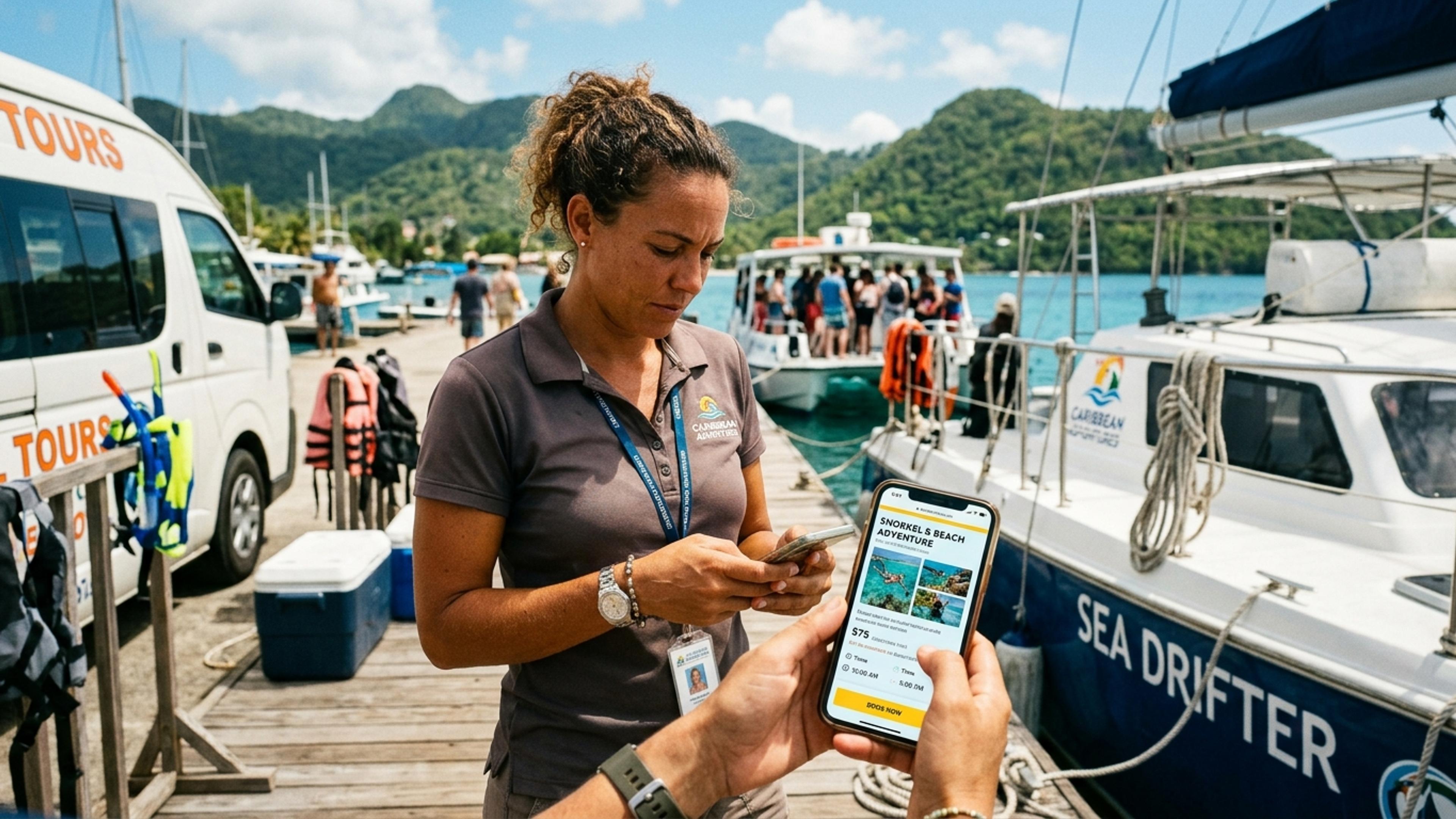
Tour operators are the business we've built for most — dive centers, excursion marketplaces, adventure companies — so this isn't theory. It's what we've learned, repeatedly, about what makes a tour operator's website actually produce bookings instead of just existing.
A tourist books an excursion in a predictable sequence: they search ("Saona island tour," "buceo Punta Cana"), they compare three or four operators in open tabs, they check prices and photos, they look for proof you're legitimate, and then they message — almost always on WhatsApp. Your website's only job is to survive every step of that sequence better than the other tabs. That framing produces every rule below.
Like hotels with OTAs, tour operators face platforms that bring volume and take 20–30% commission. The answer is the same: use the platforms for reach, and use your own site to convert the tourists who Google your name afterward — at full margin. Your site is also the only channel where you control the upsell: private options, combos, photography add-ons.
Since the excursion page is where the booking is won or lost, here's the exact structure we build, top to bottom. A headline that names the tour and the place ("Saona Island Full-Day Catamaran Tour from Punta Cana" — that's the search phrase, so it's the title). A price, immediately visible, with what's included spelled out beneath it. A 60-second summary block: duration, pickup time and zones, group size, what to bring, languages spoken. Photos and a short video of the real experience — your boat, your guides, last week's guests. The itinerary, hour by hour, because "what will we actually do" is the tourist's core question. Honest logistics: cancellation policy, weather policy, what happens if the ship is late. Reviews pulled in from Google or TripAdvisor, dated and real. And at every scroll depth, the WhatsApp button with the tour name pre-filled. A page built this way answers every objection before it's raised — which is why it outconverts a pretty brochure page several times over.
Reviews are the tour business's compounding asset, and collecting them should be a system, not luck. The workflow that works: at drop-off, the guide mentions the review ask person-to-person; that evening, a WhatsApp message thanks the guest and includes your Google review link (one tap — never make them search for you); and your website surfaces the freshest reviews on the relevant excursion page. This loop feeds three engines at once — your Google Maps ranking (review count and recency are major local-ranking factors), your page conversion (yesterday's five-star review closes today's booking), and your ad-free credibility against competitors buying their way to visibility. Fifty genuine reviews collected over a season will outperform almost any marketing spend of the same effort.
The operators who dominate tourism search long-term don't just have tour pages — they answer the surrounding questions tourists Google in the planning phase: "is Saona worth it," "what to wear whale watching," "Hoyo Azul vs Scape Park," "can you snorkel in January." Each well-written answer page ranks, builds trust, and funnels readers to the relevant excursion — and because you're a real operator with real knowledge, your answers beat the generic travel-blog fluff currently holding those rankings. Two articles a month, in both languages, is a realistic pace that compounds into a moat: within a year you're not one of five tabs the tourist compares — you're the site that answered all their questions, which makes you the default choice before the comparison even starts.
The final mile of a tour booking is money, and handling it inside the WhatsApp conversation is where Dominican operators have a home-field advantage. A payment link from a local gateway — sent right in the chat after the guest confirms date and group size — turns "we'd like to book" into a paid deposit in two minutes, before the guest's attention drifts to a competitor's tab. Deposits transform the business: no-shows collapse when guests have money down, your boat manifests firm up days earlier, and cash handling at the pickup point shrinks. The setup is straightforward — local gateways like AZUL offer payment links designed exactly for selling through WhatsApp and social media, and international guests can be offered a card link or PayPal as the alternative. The full landscape of what works for a Dominican business — AZUL, CardNET, where PayPal genuinely fits, and what each costs — is in our guide to accepting online payments in the Dominican Republic. Pair a converting excursion page with a payment link in the chat, and you've built the complete loop: found on Google, convinced on the page, closed and paid on WhatsApp — all without a platform commission touching any step of it.
A note on timing that operators consistently underestimate: tourists research excursions one to four weeks before travel, and Google needs weeks more to rank new pages. Work backward from your high season and the conclusion is always the same — the site must be built in the slow months to earn during the busy ones. The operator who launches in October owns December's searches; the one who launches in December donates them to whoever moved first. The same rhythm applies to new excursions: publish the page the day you decide to run the tour, not the day of the first departure, so Google has done its indexing work while you're still training the guides and painting the boat. Pre-launch pages can even take reservations for opening week, turning the wait into revenue.
A professional tour operator website runs around US$950 in the DR market — full pricing in what a website costs in 2026 — and the risk-free commissioning process is in our step-by-step ordering guide.
DR Web Studio has built more tour and excursion websites than anything else — it's our home category, with named local results to prove it. If you run tours anywhere in the Dominican Republic, contact us for a free consultation and we'll show you exactly what a booking machine for your operation looks like.