Business Tips
How Do Dominicans Actually Find a Local Business?
Oct 3, 2026
11 min read
consumer behaviourWhatsApp
Read More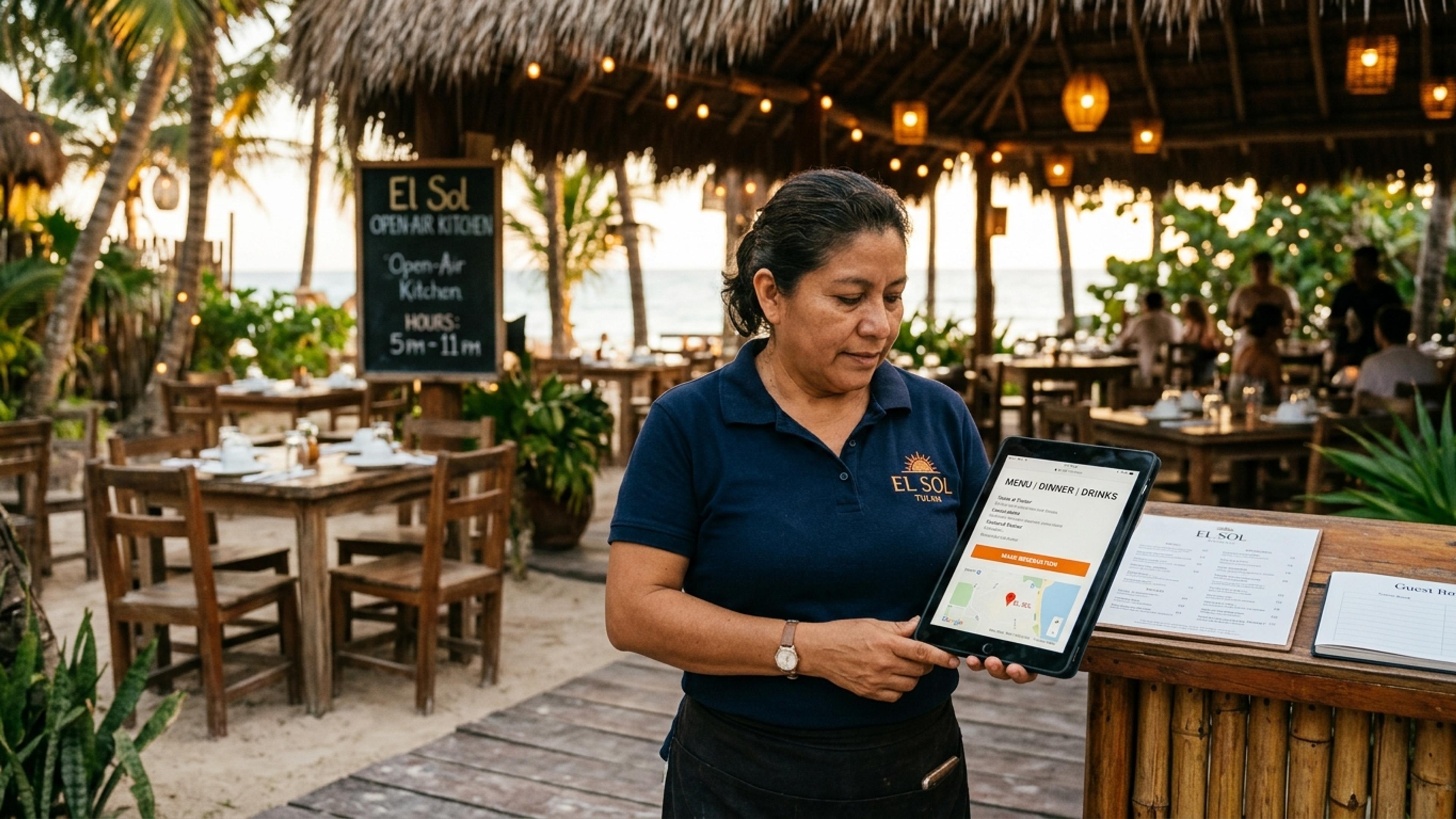
A restaurant in Punta Cana lives or dies on a simple moment: a hungry tourist or resident, phone in hand, deciding where to eat in the next hour. Your website's entire purpose is to win that moment — and most restaurant websites here lose it with a PDF menu that won't load, an address with no map, and no way to reserve. Here's what a restaurant website actually needs in 2026.
Nobody visits a restaurant site to read your philosophy; they come for the menu and the prices. Two rules. First, no PDF menus — they're slow to load on mobile data, painful to pinch-zoom, and invisible to Google, which means your dishes can't rank when someone searches "best mofongo Punta Cana." Menus belong on real HTML pages, fast and readable on a phone. Second, show prices. Hidden prices read as expensive and cost you the booking before you know it existed.
Diners in Punta Cana choose from the map: they search "restaurants near me" or a cuisine, scan ratings, and tap through. Winning there requires a complete Google Business Profile — hours, photos, menu link — connected to a website that seals the decision. If your restaurant isn't appearing in those map results, start with our guide on why businesses don't show up on Google Maps and how to fix it. Structured data helps too: marked-up menus, hours, and reviews make you eligible for the rich results Google shows hungry searchers — the how is in structured data for Dominican businesses.
Formal booking widgets have their place, but in this market the reservation almost always happens on WhatsApp — "table for 4 at 8?" — and your site should make that a single tap, with your location one more tap away on Maps and your food scrolling on Instagram. The full setup is in how to connect your website to WhatsApp, Google Maps, and Instagram.
Food photography is your strongest conversion asset and your biggest speed risk: a gallery of 5MB photos will lose the mobile diner before the first plate renders. The craft of keeping photos gorgeous and fast is exactly what we cover in image optimization for tourism websites — and it matters because speed converts directly into revenue.
A Punta Cana dining room seats tourists and Dominicans at the same tables, and they search in different languages — "romantic dinner Punta Cana" vs "restaurante para aniversario Punta Cana." A genuinely bilingual site captures both searches; the method is in bilingual SEO. Machine-translated menus, famously, produce comedy — "grilled octopus" should never become something a native speaker screenshots.
Since the menu is the site's heart, build it like a product catalog, not a scanned document. Sections as real headings (starters, mains, seafood, cocktails) so diners can jump and Google can parse. Each signature dish with a one-line description and price — the phrases people search ("fresh lobster," "mofongo," "vegan options Punta Cana") should literally appear on the page. A handful of hero photos, not one per dish — five stunning, fast-loading images beat forty mediocre slow ones. Dietary tags (vegetarian, gluten-free) that tourists actively filter by. Both currencies if you price in both, and a note on tax/service so the bill never surprises. And a last-updated discipline: nothing erodes trust like ordering from an online menu the kitchen abandoned a year ago. Structured this way, the menu page doubles as your best SEO asset — it's dense with exactly the words hungry searchers use.
Not every restaurant needs online ordering, but every restaurant should decide deliberately. If delivery apps (PedidosYa, Uber Eats) already bring you volume, the calculus mirrors the hotel-OTA story: they charge commissions of roughly 15–30%, so a simple ordering or pickup flow on your own site — even just a structured WhatsApp order message with your menu a scroll away — recaptures your regulars at full margin while the apps keep bringing strangers. Start light: a "pickup order via WhatsApp" button costs almost nothing and tests demand; graduate to a full ordering system only when volume justifies it. What matters is that the decision lives on data from your own site, not on whatever the apps deign to report.
Food photography intimidates restaurant owners into either stock photos (instantly recognizable as fake, and quietly corrosive to trust) or dark phone snaps. The affordable middle path: one half-day shoot with a local photographer, scheduled in daylight hours, covering your ten best-selling dishes, three interior/ambience shots, and the facade tourists will look for. That single session supplies the website, the Google Business Profile, and months of Instagram — three channels from one afternoon. Re-shoot only when the menu meaningfully changes. Then let your developer handle the technical half: compressing and converting those images so they stay gorgeous and fast, which — as covered above — is where most restaurant sites throw away their biggest asset.
The restaurants that win the map moment treat the website and the Google Business Profile as a single machine, maintained on a light weekly rhythm. The website is the engine — the menu, the photos, the reservation path — and the profile is the storefront Google shows first; each feeds the other, because a complete profile links to the site, and a fast site full of the right words strengthens how Google understands the profile. The weekly quarter-hour: confirm hours are right (nothing torches trust like arriving at a "closed" open restaurant — holiday hours especially), reply to the week's reviews in the reviewer's language, add one or two fresh photos, and post the week's special — which also belongs on the site if it's recurring. Once a month, check that the profile's menu link points at your fast HTML menu (not a PDF, not a delivery app), and skim the "questions" section — answers there are marketing copy tourists actually read. None of this requires a marketer on staff; it requires the habit. Paired with the structured data and Maps foundations covered above, this rhythm is what keeps a restaurant surfacing at 7 pm when fifty phones within a kilometer ask Google where to eat.
One last trust detail that costs nothing: keep the site honest about tonight. If you close for a private event, if the kitchen shuts early on Sundays, if hurricane season changes your hours — reflect it online the same day. The diner who drives to a closed restaurant doesn't blame the weather; they blame the website, and they tell Google about it in a one-star review. The habit of same-day updates is invisible when you have it and expensive when you don't. The good news is that a properly built site makes this trivial — changing hours or marking a dish unavailable should take two minutes from a phone, no developer required, which is exactly the kind of self-service content management a professional build includes by default and a rushed template rarely does. Ask for it explicitly when commissioning: the ability to edit the menu yourself, from your phone, on day one.
A professional restaurant website — HTML menu, Maps and WhatsApp integration, bilingual pages, fast photo galleries — runs around US$950; a simpler landing page with menu and reservation link around US$400. Full context in what a website costs in the DR in 2026.
DR Web Studio builds fast, bilingual restaurant websites for the Punta Cana market — built to win the "where do we eat tonight" moment. Contact us for a free consultation and let's put your menu where hungry people are searching.