Business Tips
How Do Dominicans Actually Find a Local Business?
Oct 3, 2026
11 min read
consumer behaviourWhatsApp
Read More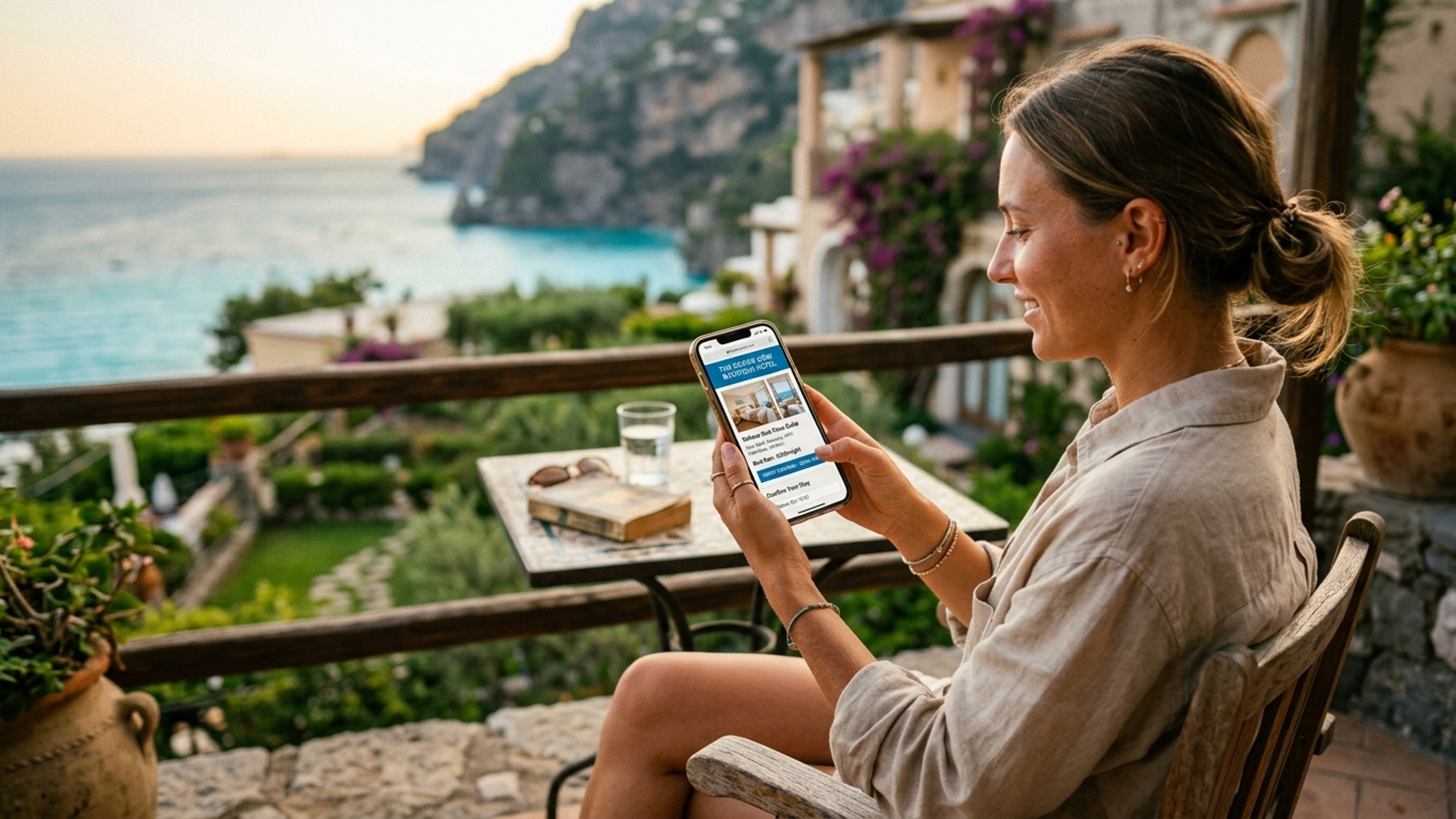
Every boutique hotel and vacation rental in Punta Cana faces the same math: the OTAs — Booking, Airbnb, Expedia — bring guests, and then take 15–25% of every one of them, forever. The only lever that changes that math is direct bookings, and the machine that generates direct bookings is your own website. Here's what a hotel or rental website has to do to earn them.
Guests almost always find you through an OTA first — then many of them Google your name to check you're real, see more photos, and look for a better price. That search is your moment. If they land on a fast, beautiful site with your full story, honest photos, and a clear "book direct" advantage (a better rate, free transfer, late checkout, a welcome drink — anything the OTA can't offer), a meaningful share will book with you and the commission stays in your pocket. If they land on a slow template, or nothing, they go back to Booking and you pay the toll.
Take a property averaging US$150/night with 60% occupancy on 8 rooms: roughly US$262,000 in annual room revenue. If OTAs handle 80% of it at 18% average commission, that's about US$37,700 a year in commissions. Shift just a quarter of those bookings to direct and you keep roughly US$9,400 — every year. A professional website costs around US$950 once. The payback isn't a projection; it's arithmetic.
For independent villas and rentals, the website does one more job: it's your legitimacy. Airbnb guests booking a US$400/night villa want to verify the property exists beyond the listing — a professional site with the villa's name, story, and gallery closes that trust gap, enables repeat guests to book direct next time, and gives you a home for the email list Airbnb never shares with you.
"Book direct" can mean three different mechanisms, and picking the right one for your size matters more than having the fanciest. An integrated booking engine (real-time availability, instant confirmation, card payment) is the gold standard for properties with steady volume — but engines carry monthly fees and setup complexity, and an engine showing stale availability is worse than none. An availability-inquiry form is the middle path: the guest picks dates, you confirm within hours — low cost, works everywhere, but the hours of delay lose some impulse bookers. WhatsApp-first booking is the underrated winner for small properties in this market: instant, personal, expected by guests in the DR, and it lets you answer questions that close the sale ("is the airport transfer included?") in the same conversation. Many of our hospitality clients run a hybrid: engine or form for the international planner type, a prominent WhatsApp button for everyone else. Whichever you choose, the rule is one visible path, never a buried one.
Your property pages sell the stay; your content pages get you found by guests who haven't heard of you yet. A boutique hotel or villa that publishes genuinely useful pages — "getting from Punta Cana airport to Bávaro," "the best beaches within 15 minutes of us," "a 3-day itinerary from our door" — ranks for the questions its future guests are already Googling, in both languages. Each of those visitors arrives pre-sold on the location and one click from your rooms. This is the same content flywheel behind every ranking tourism site we've built, and it's a game OTAs can't play for you: Booking will never rank your neighborhood guide. Two or three well-written pages per quarter is enough; the compound effect over a year is a steady stream of unpaid, high-intent traffic.
Every OTA guest is, to you, anonymous — the platform owns the relationship and masks the contact details precisely so the rebooking happens through them. Your website flips that. Guests who book direct give you their real email; add a low-key signup ("get our returning-guest rate"), a post-stay thank-you note, and one or two genuinely useful emails a year (whale season is coming, new suites open, a returning-guest discount), and you've built the only marketing channel with zero per-message cost and no algorithm in the way. For a small property, a list of a few hundred past guests who already love the place is worth more than any ad budget — and it only exists if your website exists to collect it.
If your property already has a website, run this audit before commissioning anything new — some of the highest-return fixes are small. One: open your site on a phone using mobile data, not Wi-Fi; if it takes more than about three seconds, speed is your first project. Two: count the taps from homepage to a booking inquiry — more than two is friction you're paying for in lost reservations. Three: check your rates and photos are current; an outdated rate published online creates the exact price-mistrust that sends guests back to the OTA. Four: search your property's name in Google and look at what a guest actually sees — is your site above the OTA listings, and does your Google Business Profile show your photos and correct details, or the platforms'? Five: verify your "book direct" advantage is stated explicitly; guests won't assume a benefit you don't name. Six: test the WhatsApp button from an international number's perspective — does it open correctly, and does someone answer within the hour during business times? Seven: confirm you own the domain and can access the hosting; discovering otherwise during a redesign is a painful, common surprise. Every item here either recovers commission or protects you from a bigger problem later — and the audit costs one honest hour.
One caution as you plan: resist the temptation to launch with placeholder photos or 'rates on request.' A direct-booking site earns trust by being more transparent than the OTA listing, not less — real photos, real rates, real policies from day one. Guests forgive a small property for being small; they don't forgive it for being vague, because vagueness online reads as risk. Launch complete, even if compact, and grow from there.
The commissioning process is the same as any serious business site — goal, budget, content, brief, builder — laid out in our step-by-step guide to ordering a website, with full pricing in what a website costs in the DR in 2026.
DR Web Studio builds fast, bilingual, booking-ready websites for hospitality businesses in Punta Cana. If you're tired of paying the OTA toll on guests who already wanted to stay with you, contact us for a free consultation.