Web Design
We Measured 36 Dominican Hotel Websites on Mobile. The Results Surprised Us.
Sep 6, 2026
11 min read
researchstudy
Read More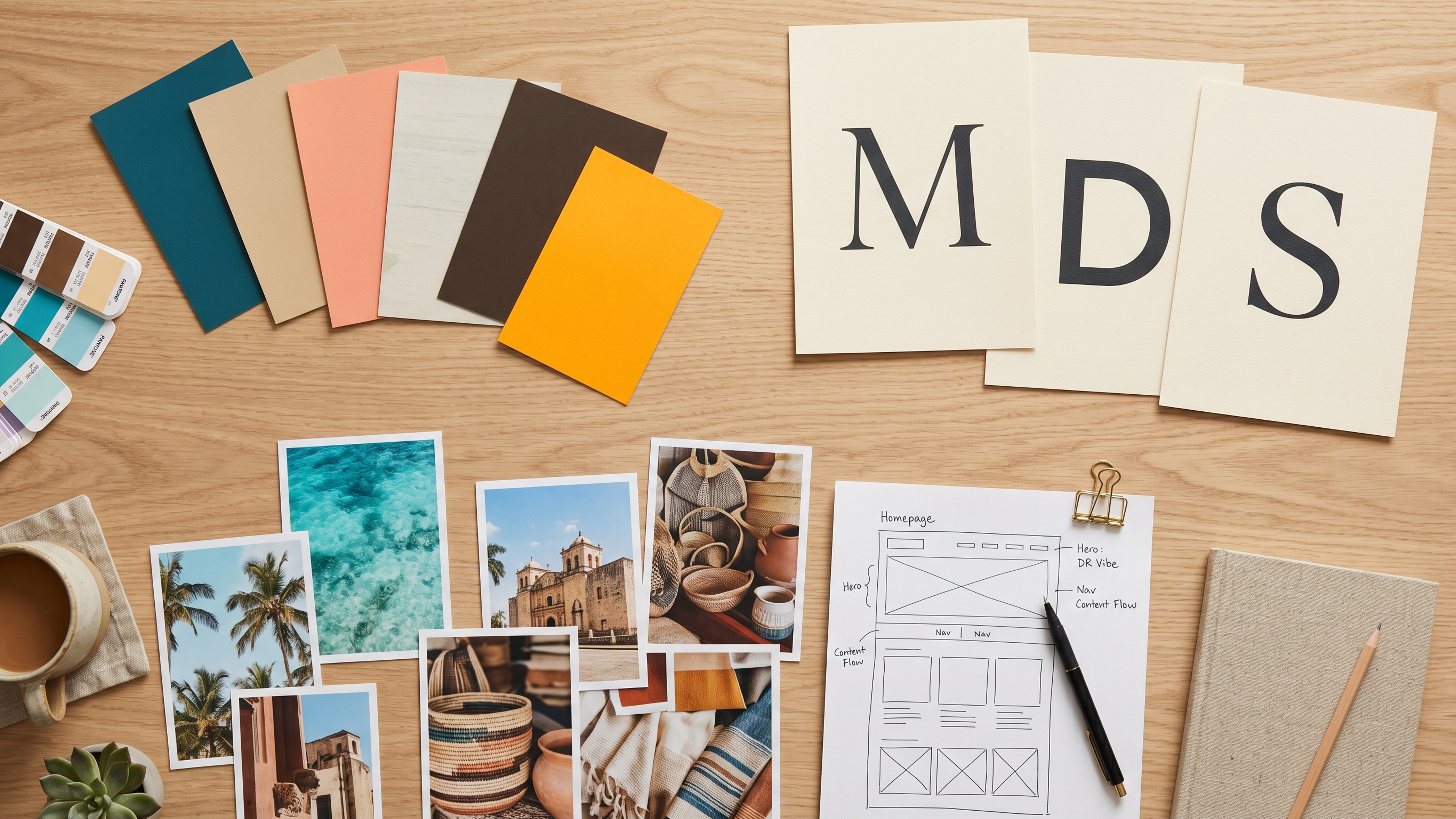
When most business owners start a website project, the design decisions feel like the scariest part. Colors, fonts, "style" — these seem like things only a trained designer could possibly get right, full of mysterious rules and good taste you either have or you don't. So owners either freeze up, or they default to copying whatever their competitor did, or they pick whatever they personally happen to like that afternoon.
Here is the reassuring truth: you do not need to be a designer to make good design decisions. You need a simple framework and a willingness to be intentional. The single most important principle in 2026 web design is exactly that — intentionality. The most successful websites are not the ones chasing the trendiest look. They are the ones where every color, font, and style choice was made for a reason connected to the business, its personality, and its customers. If a designer cannot explain why they chose a color or a font beyond "it just feels right," they are decorating, not designing.
This guide gives you that framework. By the end, you will be able to approach your colors, fonts, and overall style with confidence — and brief a designer (or evaluate one's work) like someone who knows what good looks like. None of it requires a design degree. It requires knowing your business, which you already do.
Before you think about a single color or font, answer two questions, because every good design decision flows from the answers.
What is your brand's personality? If your business were a person, how would you describe them? Elegant and refined? Warm and welcoming? Bold and energetic? Trustworthy and established? Fun and playful? Luxurious and exclusive? There is no wrong answer — there is only your answer, and it should be honest to what your business actually is. A luxury wedding photographer and a family-friendly beach activity center have genuinely different personalities, and their websites should look different as a result.
Who is your customer, and what do they need to feel? A website's design is not there to please you — it is there to make your customer feel the right thing and take the right action. A couple planning a destination wedding needs to feel that you are elegant, trustworthy, and capable of handling the most important day of their lives. A family booking a fun day out needs to feel that you are friendly, safe, and easy to deal with. The feeling your customer needs is the target your design is aiming at.
Once you can describe your brand's personality and the feeling your customer needs, you have the compass for every decision that follows. Colors, fonts, and style are simply the tools for expressing that personality and creating that feeling.
Color is the most emotionally powerful element of your design, and it does more work than most people realize. Research shows that color can increase brand recognition by up to 80%, and beyond recognition, different colors trigger different emotional responses before a visitor has read a single word. Choosing color is really choosing the emotion you want your visitor to feel.
Here is a simple, reliable approach.
Pick colors for the emotion they create. Different hues carry broadly understood associations: blue tends to communicate trust, calm, and professionalism (which is why so many businesses use it); green suggests nature, freshness, and wellness; black and deep tones convey luxury, sophistication, and exclusivity; warm tones like orange and yellow feel energetic, friendly, and welcoming; rich, deep colors feel premium while bright, saturated ones feel fun and casual. Choose a primary color whose emotional association matches the feeling your customer needs. A spa wants calm; a children's activity center wants energy; a luxury villa wants sophistication.
Build a small, disciplined palette. You do not need many colors — you need a few that work together. A reliable structure is one dominant color (often a neutral like white, off-white, or a soft gray for backgrounds — these remain the most popular and versatile choices for good reason), one primary brand color that carries your personality, and one accent color used sparingly for the things you want to stand out, like buttons and calls to action. That is often enough. The most common amateur mistake is using too many colors, which makes a site feel chaotic and unprofessional.
Balance bold with neutral. If you want a vivid, expressive color, the trick is to pair it with plenty of calm, neutral space so it has impact without overwhelming. A bright coral can be beautiful as an accent against clean white and soft gray; the same coral used everywhere becomes exhausting. In 2026, the aggressive high-contrast color schemes of a few years ago have given way to softer, more considered palettes — bold used as a deliberate accent, not a constant assault.
Never sacrifice readability or accessibility. Whatever colors you choose, text must have strong contrast against its background so it is comfortable to read for everyone, including people with visual impairments. Light gray text on a white background might look fashionably subtle, but if people have to strain to read it, you have chosen style over function — and lost. This is a hard rule, not a preference.
A note specific to the Dominican market: resist the urge to default to the obvious "tropical" cliché — the same bright turquoise, sunny yellow, and palm-frond palette that every generic Caribbean tourism site uses. It is not wrong, but it makes you look identical to everyone else. A more considered palette, perhaps drawing on a distinctive color from your actual brand or location, will help you stand out rather than blend into the sea of sameness.
If color sets the emotional tone, typography frames how your message is received — quietly, before the words are even read. The classic illustration: imagine a serious law firm using a playful, bubbly font. It instantly feels wrong, unserious, untrustworthy. The same firm in a classic, structured typeface immediately feels dependable and authoritative. That is the silent power of fonts, and it works for your business too.
You do not need to understand typography deeply. You need to understand a few categories and one rule.
Match the font's personality to your brand. Fonts fall into broad families with broadly understood feelings. Serif fonts (those with small "feet" on the letters, like Georgia or Garamond) feel traditional, established, elegant, and authoritative — well suited to luxury, formal, or heritage brands. Sans-serif fonts (clean, without the feet, like Open Sans or Helvetica) feel modern, clean, approachable, and straightforward — the most popular choice for contemporary businesses, and genuinely hard to go wrong with. Script and decorative fonts feel personal, elegant, or playful depending on the style, but should be used very sparingly. Pick a font whose personality matches the brand personality you identified at the start.
Use no more than two fonts. A reliable, professional approach is one font for headings (which can carry more personality) and one for body text (which must above all be readable). These two should complement each other without clashing. Using many different fonts is one of the clearest signs of an amateur design. Two, chosen to work together, is plenty.
Readability is non-negotiable, especially for body text. However much personality you want in your headings, the text people actually read — your service descriptions, your story, your details — must be effortlessly legible on a small phone screen in bright Caribbean daylight. An expressive font that is hard to read is a failed font, no matter how stylish. When in doubt, choose the more readable option for body text.
You do not need an expensive font. This is genuinely good news for budget-conscious owners: platforms like Google Fonts and Adobe Fonts offer hundreds of free, professional, web-optimized typefaces suitable for every industry. The most-used font on small business websites is the free, clean, highly readable Open Sans — proof that excellent typography is a matter of good choices, not big budgets.
Beyond colors and fonts, your website has an overall visual style — the way everything comes together, the amount of space, the feel of the imagery, the general impression. Here too, intentionality is the principle.
Lean toward clean and spacious rather than busy and crowded. One of the strongest design currents of 2026, which we explore in our article on web design trends for Dominican businesses, is clarity over decoration. Generous white space (it does not have to be literally white — it just means uncrowded breathing room) makes a website feel calm, premium, and easy to navigate. Cramming every inch with content, by contrast, feels stressful and amateurish. When unsure, remove rather than add.
Let your photography do the heavy lifting. For a Dominican tourism or hospitality business, your imagery is not decoration around the content — it often is the content. Beautiful, professional, authentic photography of your real location, your real work, and your real experience does more for your design than any clever effect. This is why genuine photography matters so much, and why a clean style that showcases big, high-quality images tends to win. Make sure those images are optimized so they load fast, as we cover in image optimization for tourism websites — beautiful photography that loads slowly defeats itself.
Aim for authentic, not generic. As AI tools make it trivially easy to produce generic, template-looking websites, the businesses that invest in an authentic style that reflects their real character stand out more than ever. Your style should feel like your business — its actual personality and the genuine Dominican experience you offer — not like a stock template anyone could have used. Authenticity is the one thing no competitor and no template can copy.
Above all, be consistent. Whatever colors, fonts, and style you choose, apply them consistently across every page. The same colors, the same fonts, the same spacing and feel throughout. Consistency is what makes a brand feel coherent, professional, and trustworthy; inconsistency — different fonts here and there, colors that drift, styles that change page to page — is what makes a website feel cobbled-together and amateur. Consistency does more for a "professional" feel than almost any individual choice.
Putting it all together, here is a process any Dominican business owner can work through:
First, write down your brand's personality in a few honest words and the feeling your customer needs. Second, choose a small palette — one neutral, one primary brand color matching the emotion you want, one accent for calls to action — with strong text contrast. Third, choose two complementary fonts, one for headings and one for highly readable body text, free from Google Fonts if budget matters. Fourth, decide on a clean, spacious, photography-forward style that feels authentically like your business. Fifth, apply all of it consistently everywhere.
That is a real design brief — and a business owner who arrives at a project with these decisions thought through will get a far better result, with far less back-and-forth, than one who says "make it look nice." It connects directly to the broader preparation we describe in how to brief a web developer.
Everything above empowers you to make good decisions and communicate them. But there is real skill in execution — in choosing the exact shades that work together, the precise font pairing that feels right, the spacing and proportions that make a design feel polished rather than almost-right. A good designer takes your intentions and brand personality and translates them into a cohesive, professional visual system, handling the dozens of subtle decisions that separate a site that looks genuinely professional from one that looks like a confident amateur made it.
The ideal is a partnership: you bring clear intentions about your brand's personality, your customer, and the feeling you want to create; the professional brings the craft to execute it beautifully. That is far better than either extreme — you dictating exact hex codes to a designer, or you handing over "just make it nice" with no direction at all.
At DR Web Studio, this is exactly how we work. We start by understanding your brand's personality and your customers, then build a cohesive visual identity — colors, typography, and style — designed to create the right feeling and drive the right actions, authentic to your business rather than pulled from a template. You can see the range in our portfolio: each project looks distinctly like the business it represents, not like every other site.
If you are planning a website and want help turning your brand's personality into colors, fonts, and a style that genuinely fit — and convert — request a free consultation. Come with a sense of who your business is and who your customers are, and we will help translate that into a design that looks and feels unmistakably, professionally yours.