Business Tips
How Do Dominicans Actually Find a Local Business?
Oct 3, 2026
11 min read
consumer behaviourWhatsApp
Read More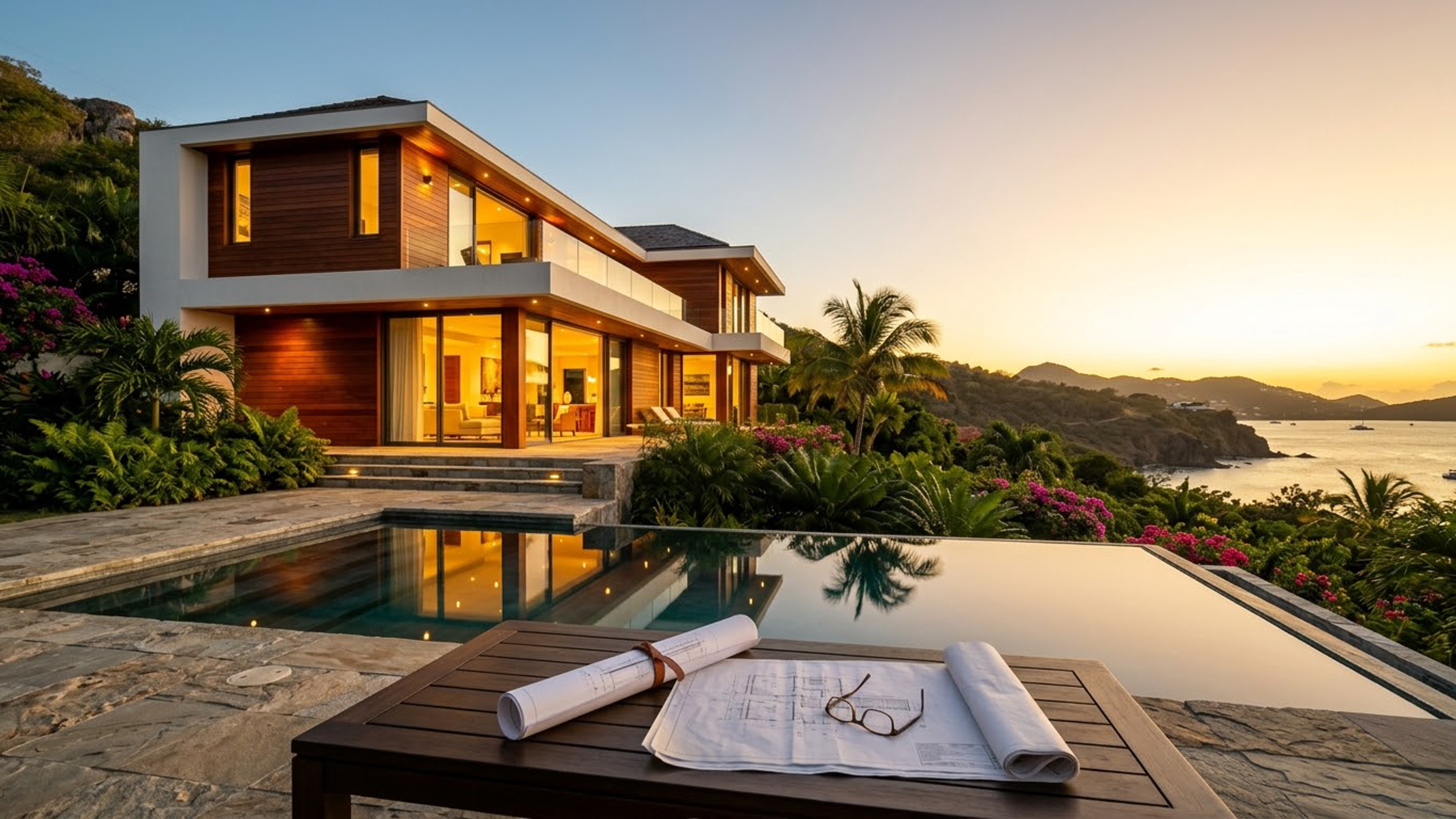
Nobody hires a builder from a paragraph. When someone is about to spend two hundred thousand dollars on a villa, gut a restaurant, or design a house they'll live in for twenty years, they don't want to read that you're "committed to excellence" — they want to see what you've actually built, and they want evidence that the process won't be a disaster. Construction, architecture, and interior design firms in the Dominican Republic operate in a market where the client is frequently foreign, often remote, and always nervous about exactly those two things. Your website is where both get resolved, or where the enquiry quietly goes to someone else.
Every prospect in this vertical is silently asking the same thing: can I trust you with a lot of money and a long timeline? That question has two halves, and most firm websites answer only the first.
The first half is capability — can you actually produce work of the quality I want? That's what a portfolio answers, and it's the part firms understand. The second half is process — will this project run properly, will I know what's happening, will it finish, will it cost what you said? That's the fear behind every construction enquiry, and it's especially acute in the Dominican market where a foreign client is commissioning work in a country they don't live in, in a legal and permitting system they don't understand, sometimes in a language they don't speak. A firm that addresses that fear directly on its website separates itself from every competitor showing pretty pictures and nothing else.
The portfolio is your proof, and how it's structured determines whether it persuades.
• Show complete projects, not scattered images. A gallery of forty disconnected photos demonstrates less than four projects shown properly. Each project deserves its own page: what the client wanted, the constraints, what you did, and a sequence of images that tells the story.
• Before-and-after is the most persuasive format in this industry. Renovation and interior work lives or dies on transformation, and nothing else communicates value so immediately. Firms consistently under-use this because they didn't photograph the "before" — start doing it on every job from now on.
• Include the practical facts. Location, scale, duration, and materials. A prospect is calibrating whether you've done work of their size — a firm whose portfolio is all small apartments reads as risky for a villa, and vice versa, and you want the right clients enquiring.
• Photograph the work properly. This is the industry's most common self-inflicted wound: excellent buildings documented with hurried phone snaps in bad light. Professional architectural photography is a real investment that pays back across every future pitch, and it's worth building into project budgets. In the meantime, the phone-and-good-light method applies here too — shoot in daylight, keep verticals straight, tidy the space first.
• Keep it fast. Large photography is the heaviest content on the web, and a portfolio that doesn't load persuades nobody — the image optimization that keeps galleries beautiful and quick is what makes the proof actually reach the client.
Here's the opening in this vertical. Almost every construction and design firm shows projects; almost none explains how a project actually runs. Yet that's precisely what a nervous client wants to know, and answering it builds more trust than another gallery.
Lay out the stages plainly: initial consultation, site assessment, concept and drawings, quotation, permits, construction phases, inspections, handover. Say roughly how long each takes. Explain how payments are structured, how changes are handled, how often the client hears from you and through what channel. For foreign clients especially, address the questions they can't answer themselves — how permitting works in the DR, what a client must provide, whether you handle regulatory approvals, how you manage a project for an owner who is abroad for most of it. A firm that publishes this reads as organized and experienced before a single conversation, and it filters out mismatched enquiries at the same time.
This vertical serves distinct audiences, and the site should speak to all of them:
• Foreign clients building or renovating. Villa owners in Punta Cana, Cap Cana, Sosúa, or Las Terrenas, frequently managing the project remotely and researching entirely in English months ahead. They need the process explained, the credibility established, and communication reassurance above all. This audience overlaps directly with the real estate market and the luxury standard of Cap Cana.
• Local Dominican clients, residential and commercial, searching in Spanish, often through referrals but always verifying online afterwards.
• B2B and developer work. Hotels, restaurants, offices, and property developers commissioning larger contracts — a smaller audience with far higher value, evaluating you the way any professional service is evaluated: credibility, track record, capacity.
Serving all three well means genuinely bilingual pages and separate pages per service — architecture, construction, renovation, interior design, project management — so each ranks for its own searches rather than one page competing for everything.
In a market where anyone can claim to be a contractor, specific evidence carries weight — and the visual quality of the site itself is part of that evidence. Stanford's research on web credibility found that people judge an organization's trustworthiness substantially from how professional its site appears, which in a design and construction context is doubly damning: a firm selling aesthetic judgment through an unattractive website is arguing against itself. Beyond that, the concrete signals: licensing and professional registration, years operating, insurance, the size of your team, and — most persuasively — named client testimonials tied to visible projects. Photographs of your actual team and site work outperform stock imagery dramatically, because this industry's central anxiety is whether a real, stable organization is behind the promises. If you've worked with recognizable hotels, developers, or brands and you're permitted to say so, that reference does more for a large prospect than any amount of adjective-laden copy.
Construction and design projects have unusually long decision cycles — a foreign owner may think about a renovation for a year before commissioning anyone — and that's an opportunity most firms waste. During those months, the prospect is searching: what does it cost to build a villa in the DR per square meter, how long does construction take here, what permits are needed, can a foreigner build on land they own, what should be in a contract, how do you supervise a build remotely. Every one of those is a page a firm could own, and almost nobody has written them. The firm that answers becomes the expert the client already trusts by the time they're ready to commission — and the enquiry that arrives is warm, informed, and far less price-sensitive than a cold comparison. It's the same content strategy that works in professional services, and it fits this vertical even better because the purchase is larger, the research longer, and the anxiety higher.
Worth naming directly: construction has a trust deficit almost everywhere, and in the Dominican market foreign clients arrive having read cautionary stories about projects that overran, budgets that grew, and contractors who disappeared. You didn't create that reputation, but your website has to work against it. The firms that win do so by being unusually concrete where competitors are vague — real timelines rather than "quickly," explained payment stages rather than "flexible terms," named references rather than anonymous praise, and honesty about what you don't do. Specificity reads as confidence. It's also the one differentiator that costs nothing to implement and that most competitors won't bother with, which is precisely why it works.
At DR Web Studio we build portfolio-driven websites for construction, architecture, and design firms — project galleries that load fast and tell the whole story, process pages that answer the client's real worries, bilingual throughout, with clear enquiry paths and the first year of maintenance included. If your built work is stronger than the website representing it, contact us for a free consultation and let's make the proof match the projects.