Business Tips
What the Dominican Government Actually Publishes About Digital Adoption
Oct 18, 2026
10 min read
ENHOGARINDOTEL
Read More
"Why do I need a website? I have Instagram." It's one of the most common questions Dominican business owners ask, and it deserves a better answer than the defensive one web developers usually give. Instagram is genuinely powerful here — it drives real discovery, real bookings, and real revenue for thousands of businesses across the country. The problem isn't that people overvalue Instagram. It's that the two tools do fundamentally different jobs, and using one to do the other's work leaves money on the table in ways that are invisible until you look for them. Here's the honest division of labour.
Let's start by taking it seriously. Instagram is the best discovery tool most Dominican small businesses have ever had access to, and it costs nothing.
It's visual, which suits almost everything this country sells — food, beaches, rooms, hair, events, views. It's social, so a satisfied customer's story reaches their entire network for free. It's immediate: you can post today and have enquiries this afternoon, with no waiting for Google to index anything. It builds personality and familiarity in a way a static page struggles to, letting customers see the people behind the business. And in a market where trust is everything, an active feed with real photos and real comments is credible in a way that a polished but silent brochure page isn't.
If you have limited time and one channel, and you're just starting, Instagram is the right first move. That's not a concession — it's genuinely correct.
Now the other half, and each of these is a real cost rather than a theoretical one.
It doesn't appear when someone searches. This is the big one. The scale of the gap is worth seeing in numbers: DataReportal counted 7.89 million social media user identities in the Dominican Republic against 10.5 million internet users, with online penetration at 91 percent of the population. Social reaches roughly two-thirds of the country; the open web reaches nearly all of it — plus every foreign visitor and buyer who never appears in those figures at all. When a tourist types "restaurant Bávaro" or "villa rental Las Terrenas" into Google, your Instagram profile is essentially absent from those results. That's an enormous stream of high-intent demand — people actively looking to buy right now — that a profile simply cannot capture. Everything you've built on Instagram is invisible to it.
It can't be organized. A feed is chronological. It can't have a services page, a price list, a page per excursion, an FAQ, or a proper gallery by category. A customer trying to find out what you charge or what's included has to scroll, guess, or ask — and many won't.
It can't take a booking or a payment properly. Every transaction becomes a manual conversation, which is fine at ten enquiries a week and impossible at a hundred.
It shows your work badly. Compressed images in a fixed crop is a poor way to present photography, interiors, rooms, or food you spent money to shoot properly.
And you don't own it. This is the one that ends businesses. An account can be hacked, restricted, or suspended, sometimes with no clear reason and no fast appeal — and with it goes your entire body of work, your customer conversations, and your audience. Businesses in the DR lose accounts every month. The ones with a website carry on; the ones without start from zero.
The productive way to think about it: Instagram wins attention. Your website converts it and keeps it.
Instagram is the top of the funnel — discovery, personality, social proof, staying visible to people who already know you. The website is everything after: the full picture, the details, the prices, the proof, the booking, the payment, and the searchable presence that reaches people Instagram never will. One brings people in; the other turns them into customers and makes sure you can reach them again.
Used together, they compound. Your Instagram bio links to your site. Your site displays your Instagram feed and links to the profile. A story about a new excursion links to the excursion page where someone can actually book it. The customer who found you on Instagram lands somewhere that answers every question and takes a deposit, rather than on a chat where you'll answer the same five questions for the two-hundredth time.
A practical split for a Dominican business:
• Instagram: daily life of the business, new work, behind the scenes, promotions, stories, replies to comments, building familiarity and being remembered.
• Website: full service descriptions, pricing, availability and booking, galleries organized by category, the questions customers actually ask, credibility signals, contact options, and everything you want Google to find.
• Both: the same photographs, working twice — and WhatsApp connecting the two, since in this market that's where conversations actually close regardless of where they started.
The test for any piece of content: would someone search for this? If yes, it needs to live on your site, where search can find it. If it's about being seen by people who already follow you, Instagram is the place.
Two local realities sharpen this. First, the tourist market. A visitor planning a Punta Cana trip from Toronto in February searches Google — they don't browse Instagram hashtags looking for a tour operator. If your presence is Instagram-only, you are structurally invisible to the highest-value segment of the Dominican economy, no matter how good your feed is. The same applies to the diaspora, foreign property buyers, and relocating families, all of whom research through search.
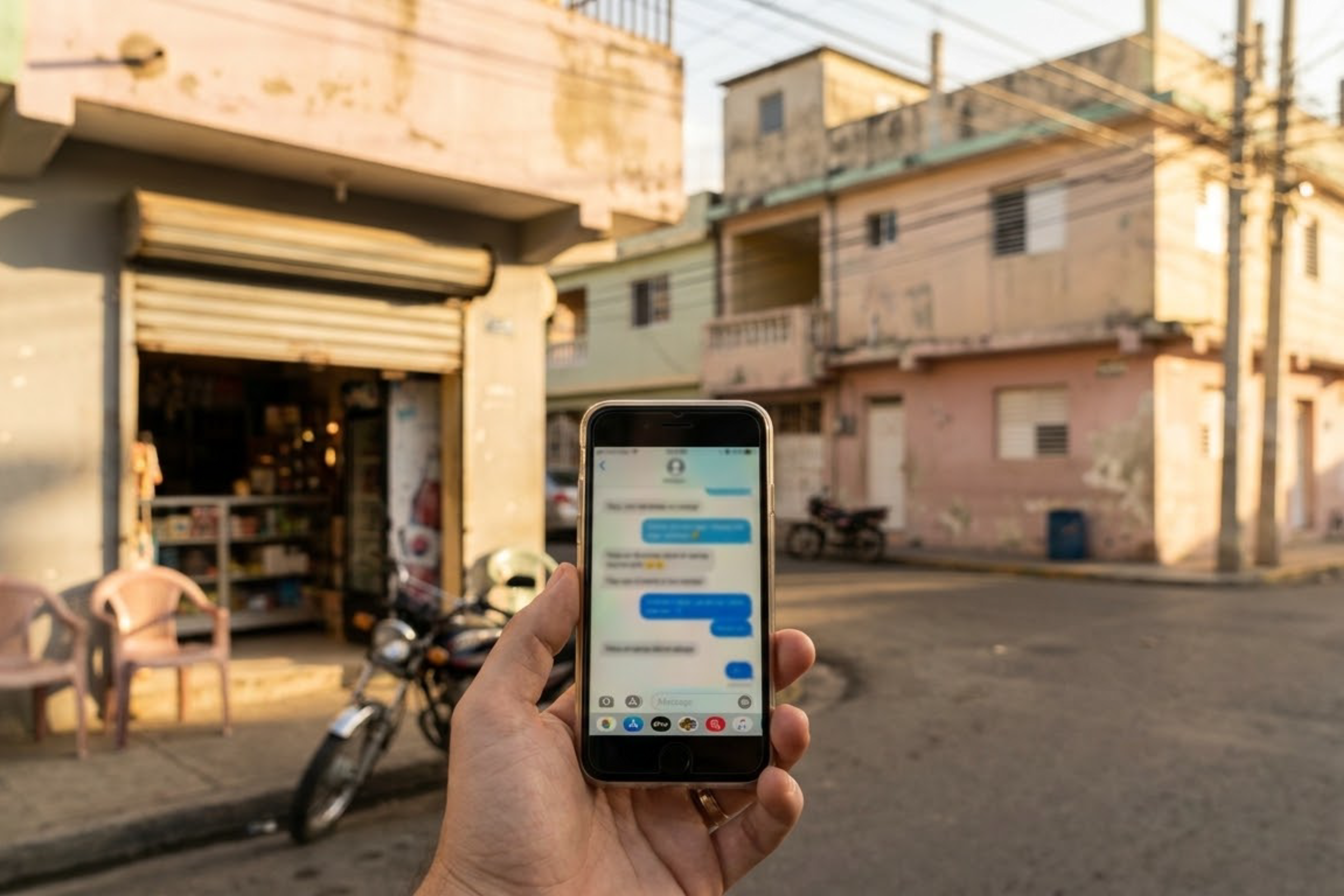
Second, WhatsApp. In the DR, WhatsApp — not Instagram DMs — is where deals get done. That means the ideal path is: Google or Instagram brings them in, the website persuades and answers, and WhatsApp closes it. A business relying on Instagram alone is missing the first step for a huge share of its potential customers and doing the second step manually.
The same logic applies across every platform, with local nuances worth noting. Facebook remains genuinely important in the Dominican market — often more so than Instagram for reaching older customers and for community groups, where recommendations circulate constantly and where a great many local buying decisions actually begin. TikTok drives real discovery for food, nightlife, and anything visually surprising, and it reaches a younger audience that increasingly uses it as a search tool in its own right.
But none of them changes the underlying division. They are all rented attention: algorithm-dependent, unsearchable by Google in any meaningful way, unable to take a booking, and revocable without notice. The strategic position is the same regardless of which platform you favour — use whichever ones your customers actually use for reach and personality, and point all of them at one destination you own. A business with four social accounts and no website has four landlords and no property.
The real objection isn't philosophical, it's practical: Instagram is free and a website costs money, and posting is something you can do between customers while a website feels like a project. Both are true. But the comparison worth making is what each demands over time. Instagram requires constant feeding — stop posting for a month and your reach collapses, because the platform rewards recency. A well-built website is largely the opposite: build it once, maintain it lightly, and it keeps working while you sleep, accumulating search rankings that compound rather than decaying. One is a treadmill you can never stop running; the other is an asset that appreciates. Most businesses need both, but they should understand that they're paying for Instagram too — in hours, forever.
At DR Web Studio we build the website side of this equation: fast, bilingual sites that get found on Google, show your work properly, take bookings and payments, and connect straight to WhatsApp and your Instagram — so the audience you've built on social has somewhere to land that actually converts, and the customers searching Google can find you at all. If your Instagram is working hard and you suspect it's carrying more than it should, contact us for a free consultation and let's split the work properly.