Business Tips
There is a restaurant in Santo Domingo with 16,431 Google reviews. It is one of the most-reviewed businesses in the entire country — an institution, genuinely loved, the kind of place people take visiting relatives.
Its website is a single image. The image says: "Nuestra página web está en construcción."
We found it while checking 64 Dominican restaurants for working online menus. Its menu does exist online, as it happens — as a PDF somebody uploaded to Scribd. Not the restaurant. Somebody.
That site has been under construction for long enough that the phrase has stopped meaning anything. And it is not unusual. Across our studies of Dominican hotels, restaurants and service businesses, the abandoned website is one of the most common things we find — and one of the few that is genuinely worse than having no website at all.
The phrase implies progress. Someone is building. Come back later.
That is almost never what it describes. In practice a construction page means one of a small number of things, none of which resolve on their own:
The project stalled on content. The developer built the container and asked for text and photos. They never arrived — not out of laziness, but because writing about your own business is genuinely hard and there was always something more urgent. The site has been ninety percent finished for two years.
The person building it disappeared. A relative, a friend's nephew, a freelancer who got a full-time job. It's nobody's fault and there's no contract, which is precisely why nothing has happened since.
The domain outlived the plan. Somebody registered it, put a placeholder up, and moved on. The placeholder renews automatically every year, faithfully, forever.
Nobody knows how to change it. The logins are with someone who left. This is the one that turns a small problem into a large one.
What these share is that no amount of waiting fixes them. The page is not a stage in a process. It is the process having stopped, with a sign on it.
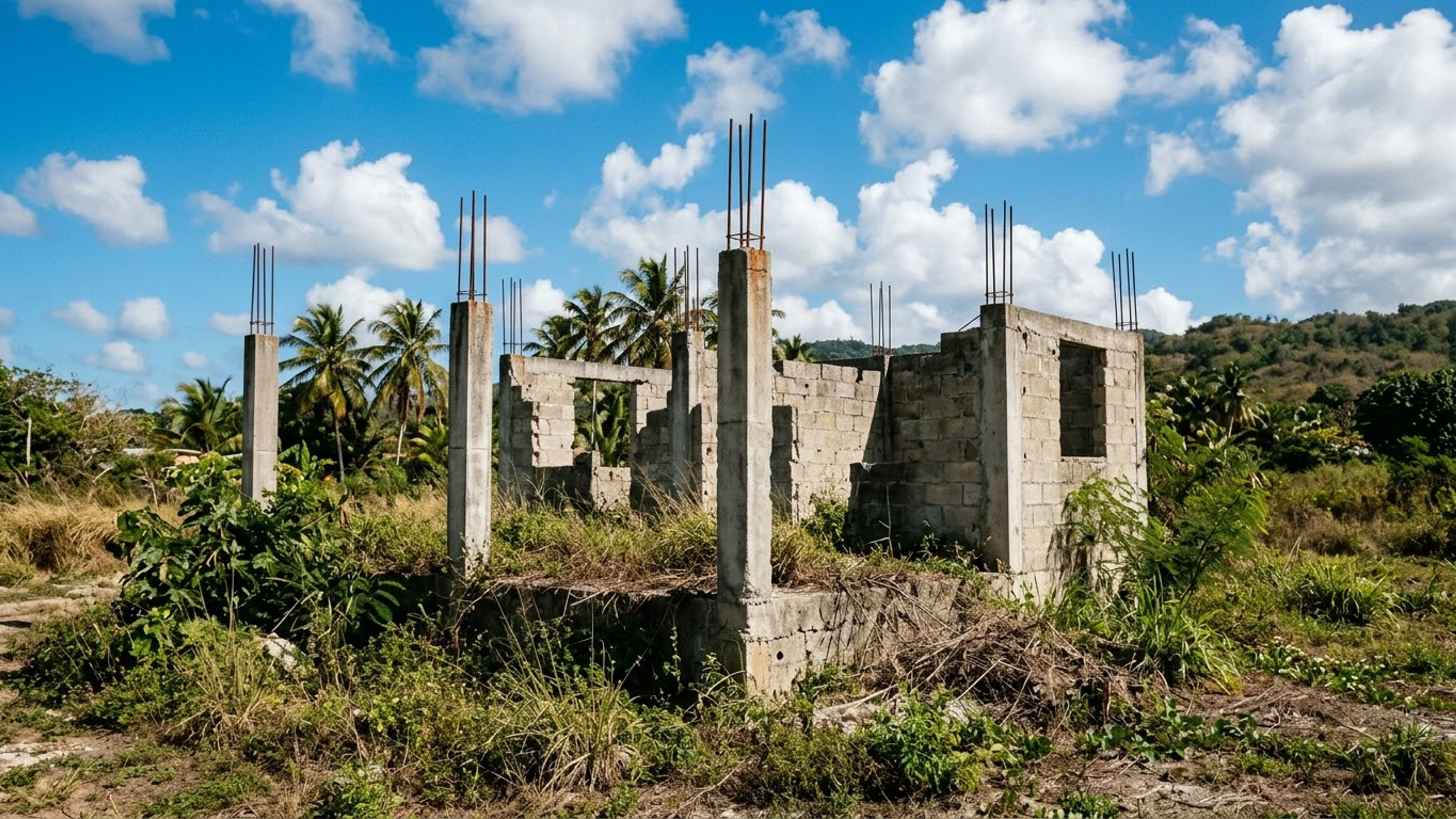
An empty lot is neutral. A half-built house with a sign on it is a statement.
It tells customers you stopped. A visitor who lands on a construction page doesn't think "ah, they're improving things." They think this business may not be running properly. Stanford's long-running research on web credibility found that people judge how trustworthy an organisation is substantially from how professional its site appears — and a blank page is the most unambiguous signal available. In a market where trust is already the biggest obstacle for a small business, that's an expensive impression to leave sitting on your own domain.
It's the destination for everything else you do. Your Google listing links there. Your Instagram bio links there. A customer who heard about you from a friend types your name and lands there. Every referral in your business funnels into a page that says nothing.
It occupies the address you'll eventually want. Search engines have indexed it. Whatever authority your domain accumulates is attached to a page with no content, and the longer it sits the more of your own name it owns.
It blocks the things that actually work. You can't put a menu on it, or prices, or services. You can't point your Google listing at anything useful. You can't be found for anything you sell, because there's nothing to find.
The restaurant with 16,431 reviews is the clearest possible demonstration. The business is thriving. The reputation is enormous. And the one asset it fully controls says nothing at all.
A construction page is the honest version. These are the disguised ones, and we found all of them in the field:
The unfilled template. One Santo Domingo parrillada trading since 1996 has a live menu page listing eighteen dishes, every one called "Platillo 1," each with the placeholder line "Precio." The browser tab still reads Título del sitio. The logo in the header still belongs to the template. The restaurant's name appears nowhere on its own menu page.
The unedited demo. A Cabarete beach club's website is an untouched Squarespace demo — Cobb Salad 9, Cheese Sampler 15, under headings that still say "Add a description about your starters." Not one Dominican dish. Not one peso price.
The site that's stopped working. One well-known Santo Domingo restaurant's site returns a database connection error. Another's is blocked by browsers on an expired certificate. Both are "live" in the sense that the domain resolves.
The frozen site. Everything's filled in, but the copyright says 2014, the news page stops in 2019, and the menu is a PDF named for 2023. Nothing is broken. Nobody is home.
All four cost what the construction page costs, and all four are harder to notice, because the owner sees a website and assumes it's working.
The instinct is to finally do the big project properly. That instinct is why the page has been up for two years — the full build feels large, so it keeps not happening.
Do the small thing instead.
Day one: one real page. Your business name, what you do, where you are, opening hours, phone, WhatsApp, and either your menu, your services or your prices as actual text. One page. It does not need a design. It needs to not be blank.
That single page beats the construction notice by an enormous margin, and it can genuinely be done in an afternoon.
Day two: find your logins. Who controls the domain? Who controls the hosting? If the answer is "the guy who built it," resolve that now, while the stakes are low. It's the ownership problem that turns a cosmetic issue into an expensive one.
Day three: fix the listing. Point your Google Business Profile at the new page and check the link as a customer would. In our restaurant study, one in six businesses had a Google link pointing at something dead.
Then grow it. Add a page a month if that's the pace you can sustain. A modest site that exists outperforms an ambitious one that doesn't.
The construction page is a symptom of a website with no owner. So the durable fix isn't the page — it's deciding who is responsible for it.
One person in your business, named, whose job includes looking at the website once a quarter and asking three questions: does it load, does it say what we actually do now, and does every link still work? Twenty minutes, four times a year. That is the entire difference between a site that ages and a site that dies.
If nobody can be that person, that's what a maintenance arrangement is for, and it's cheaper than the rebuild you'll otherwise need in three years.
We're not writing this to mock anyone, and we haven't named a single one of the businesses above for that reason.
Every abandoned site we've found belongs to someone who was doing something more urgent. The restaurant with sixteen thousand reviews got those reviews by running a restaurant, not by managing a domain. The parrillada trading since 1996 has survived three decades of a hard business. These are not careless people. They are people for whom the website was always next month's problem, and next month's problem is an infinitely renewable resource.
The only real argument against leaving it is that it gets more expensive the longer it sits — not in money, but in the customers who typed your name, found a page that said nothing, and quietly went somewhere else.
At DR Web Studio we build sites in weeks rather than eventually, with your domain and hosting in your own name, and the first year of maintenance included so the site doesn't quietly stop again. If your business is stuck behind a construction page — or a template nobody finished — contact us for a free consultation and we'll tell you honestly how big the job actually is. Sometimes it's smaller than you think.