Business Tips
We Asked Four AIs for a Vet. One Recommended a Clinic That Closed in 2020.
Sep 18, 2026
11 min read
AI searchresearch
Read More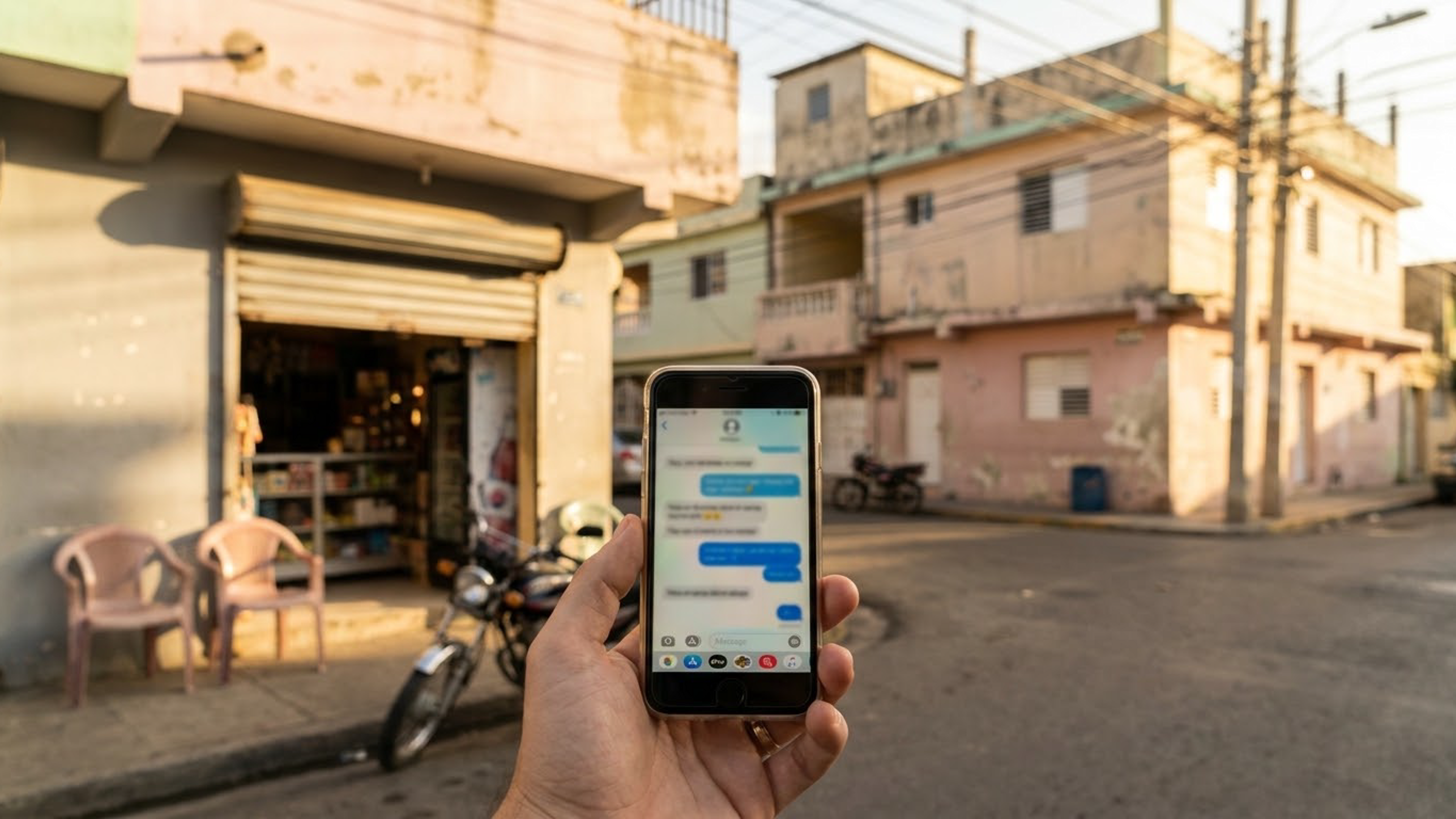
Over the past year we've measured a lot of Dominican websites. We ran 36 hotel sites through PageSpeed Insights, checked 64 restaurants for working online menus, fingerprinted 200 business sites by platform, and put 208 queries to four AI assistants. Together that's measurements on several hundred businesses.
Every one of those studies measured the supply side — what businesses publish, how fast it loads, whether it works. Not one of them measured the thing that actually determines whether any of it matters: what a Dominican person does when they need a plumber.
That's a real gap in our own work, and we want to be straight about it. This article is not a study. It's our best reading of what published data and our own findings suggest about how people here find local businesses — along with where that reading could be wrong, and what it would take to actually know.
Start here, because it's the number that matters most and it doesn't look like a web statistic at all.
Across Caribbean markets, WhatsApp penetration in the Dominican Republic sits at around 91%, against 76% for Facebook, 52% for Instagram and 15% for LinkedIn. WhatsApp isn't the leading messaging app here. It's more widely reached than any other digital channel in the country, by a wide margin.
The commerce data points the same way. 82% of Dominican online shoppers use WhatsApp to make purchases, which makes this one of the most WhatsApp-dependent retail markets anywhere.
And then there's the observation that should give any web agency pause. Writing about survey methodology in this market, one research group notes that smartphone penetration reached about 68% of adults, but that mobile data remains cost-constrained for lower-income segments and that a significant portion of internet usage happens via WhatsApp and social media rather than browser-based activity.
Read that again from a website-selling perspective. A meaningful share of Dominicans are online without being on the web in the way the standard advice assumes. They're in apps. The browser is something they open when they have to.
We can't prove the next part. But here's the reasoning, and we think it's sound.
If a large share of digital life runs through WhatsApp and Facebook rather than a browser, then the first move when someone needs a local business is probably not typing a query into Google. It's more likely one of:
• Asking the family WhatsApp group, or the neighbourhood group, or the building group
• Asking a specific person who'd know
• Posting in a local Facebook group
• Already knowing who to call, because they used them before or their cousin did
That isn't a Dominican peculiarity so much as an acceleration of something true everywhere: personal referral is the oldest search engine and it still works. What's distinctive here is the infrastructure. A WhatsApp group of forty neighbours is a search engine with a very small index and extremely high trust, and 91% of the country is on it.
Google almost certainly still dominates in specific situations — and we'd guess those situations are: when nobody in your network has an opinion, when the category is unfamiliar or specialist, when you're new to an area, and above all when the person searching isn't Dominican. A tourist in Bávaro and a foreign buyer in Sosúa have no WhatsApp group to ask. They have a search box.
Three findings from our studies fit the picture, and one complicates it.
Businesses behave as though Google Maps is the front door, not the website. In our restaurant study, 98% of the 64 restaurants had a Google Business Profile while only 47% had a website of any kind. Businesses are rarely wrong about where their customers come from — they can't afford to be. That split is a strong signal about which surface actually produces walk-ins.
Most small businesses have no website at all. When we checked 20 small hotels and guesthouses from OpenStreetMap listings, 12 of the 16 we could identify had no website whatsoever. They're trading successfully, with reviews and bookings, through platforms and word of mouth. A market where that's survivable is not a market where the website is the primary discovery channel.
And the stable layer isn't the clever one. Across eleven repeat checks in our AI study, Google's ordinary local map results were 100% stable — not one rating, review count or snippet changed — while every AI answer above them churned. The boring listing is the load-bearing surface.
The finding that complicates it: businesses with websites did get recommended more by AI assistants, and our car-rental example was reached by two different systems purely because it published its rates as text. So the website clearly does something. The question is what, and we think the honest answer is less "it finds you customers" and more "it converts the ones a referral already sent."
If all that's right, the website's job in this market is probably not discovery. It's confirmation.
Someone in a WhatsApp group says llama a este plomero. The recipient doesn't just call. They search the name. What they find in the next ten seconds either confirms the recommendation or quietly kills it — and in our studies, what they'd find is frequently a Maps listing pointing at a dead domain, a page that says "en construcción," or nothing at all.
That reframes the advice without weakening it. Your website isn't competing for strangers' attention against the whole internet. It's the thing that has to be there, and credible, at the moment somebody checks you out — which happens after the referral, not instead of it. That's a smaller job and a more winnable one, and it explains why a complete Google listing outperforms almost anything else you could do.
The other reason to resist a single answer is that "Dominicans finding businesses" isn't one behaviour. There are at least three populations here, and the evidence suggests they diverge sharply:
Dominican locals, who have networks, speak the language, and whose first move is likely social or personal. Google when the network has nothing.
Foreign residents and expats, who have networks too — but theirs are Facebook groups and forums rather than family, and who search in English for things their Dominican neighbours would just ask about.
Tourists, who have no network at all, research from another country weeks ahead, and are almost entirely dependent on search, Maps, TripAdvisor and whatever an AI assistant tells them.
A restaurant in Gazcue and a tour operator in Bávaro are in different businesses as far as discovery is concerned. Most advice written for "Dominican businesses" — ours included — has been too quick to treat them as one.
We want to be precise about the limits here, because it would be easy to dress this up as more than it is.
This is not a survey. We have not asked a single Dominican consumer how they find a business. Everything above is inference from published market data and from our own supply-side measurements.
The sources have limits. The penetration figures are platform and market estimates, not behavioural observation. "91% WhatsApp penetration" means people have it, not that they use it to find a plumber.
Our own studies sampled businesses, not people, and sampled them from Google Maps and guidebooks — which structurally over-represents businesses that are already findable online.
And we have an interest in the answer. We sell websites. A conclusion that websites matter less than referral is against our commercial interest, which is some reason to trust it — but the opposite conclusion would have been easier to reach and we want that on the record.
A proper demand-side study, and we'd like to run one. The design we'd use:
Ask people about a specific recent incident rather than their general habits — "think of the last time you needed a plumber; what was the very first thing you did?" — because general questions produce the behaviour people think is normal rather than what they did. Randomly assign one category per respondent across restaurants, trades, medical, hotels, mechanics and professional services. Record the first action, every subsequent action, how they finally decided, and whether they looked at a website at any point.
The hard part isn't the questionnaire, it's recruitment. If you distribute a survey through Instagram and an email list, you sample people who are online and then discover that people find businesses online. It has to be collected in person, in several cities, across age groups — which is a few weekends of work that no tool can do for you.
Around 200 responses would give headline figures worth publishing, with subgroup splits reported as patterns rather than conclusions.
If that study contradicts what we've written above, we'll publish that too. We've already had three studies correct our own assumptions — the bilingual gap we expected in hotels and didn't find, the restaurant fix that turned out to be free, the website correlation that reversed in one category. Being wrong in public has worked out better for us than being vague in public.
The practical advice doesn't change much, and it's reassuringly cheap:
Get the Google listing right first. It's free, it's the surface our data shows is most stable, and 98% of the restaurants we checked had one while only 47% had a website. Our thirty-minute audit covers it.
Make WhatsApp obvious everywhere. In a market with 91% WhatsApp penetration, the contact form is the second-best option. Wire it into every page.
Build the site for the person checking you out, not the person discovering you. Real information, real prices if you can, loading fast on a phone — because the ten seconds after a referral is probably where it earns its money.
And if you serve tourists or foreign buyers, treat them as a separate problem. That audience genuinely does discover through search, in English, months ahead. Everything the standard advice says applies to them. It may apply much less to the family down the road.
At DR Web Studio we publish what we measure and flag what we've only inferred — this article being the second kind. If you'd like us to look at what someone actually finds when they check your business, contact us for a free consultation.