Business Tips
What the Dominican Government Actually Publishes About Digital Adoption
Oct 18, 2026
10 min read
ENHOGARINDOTEL
Read More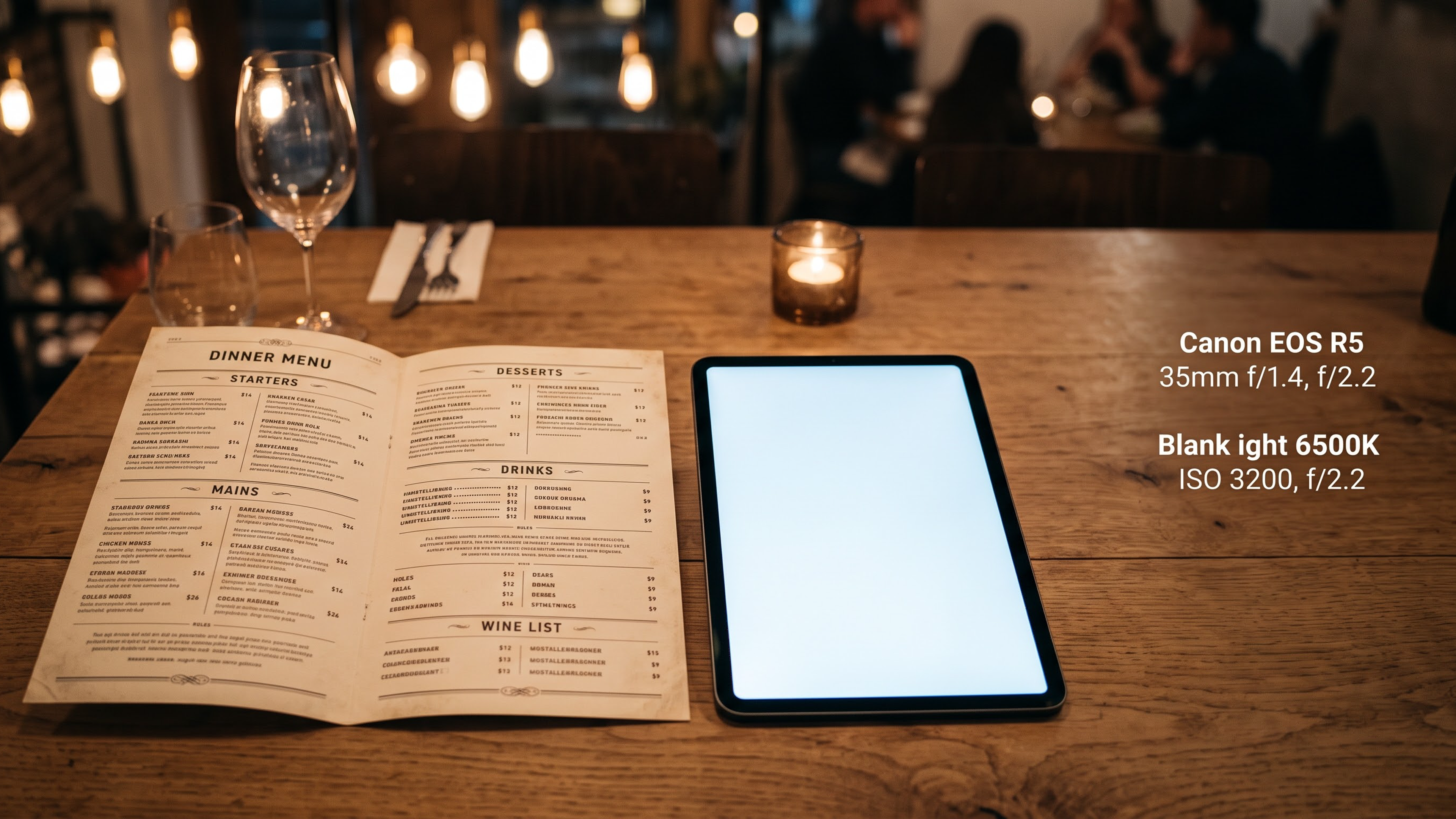
There is a rooftop restaurant in Santiago with a genuinely beautiful menu. Proper typography, considered layout, peso prices, the whole thing designed with care by someone who knew what they were doing. We found it while checking 64 Dominican restaurants for working online menus.
It returns zero text to a browser. Not a little. None. Every word on that menu is baked into an image file, which means that to a human being it looks excellent and to a search engine it does not exist. Somebody paid for that design. It is doing almost nothing.
This is one of the most common and least understood mistakes a restaurant can make online, and it is entirely fixable. Here's what's actually happening.
When you look at a web page, you can't tell the difference between these two things, but a machine can:
Real text is characters the browser has been sent — words it can select, copy, resize, translate, and read aloud. Search engines read it. Screen readers read it. Your phone can make it bigger.
Text in an image is a picture of words. To software it's a rectangle of coloured pixels, no different from a photograph of a beach. You can't select it, copy it, or search within it. Neither can Google.
A PDF sits somewhere between the two — sometimes it contains real text, often it's a flat image, and either way it's a separate file that behaves badly on a phone.
Every menu published as a JPG, a PNG, a designed graphic, or a scanned PDF falls in the second category. It looks identical to the first category to you. It is completely different to everything else that matters.
Google can't index a word of it. When someone searches "restaurante mofongo Santiago" or "where to eat lobster in Bávaro," Google matches against text it can read. If your dishes exist only inside a picture, none of them are in the index. You are invisible for every dish you serve — which is to say, for most of the searches your future customers actually type.
It breaks on the phone your customer is holding. An image or PDF menu doesn't reflow to fit a screen. The customer gets a full page shrunk to phone width, then pinches and drags around a document designed for A4 paper, hunting for the prices. Many give up. This is not a minor inconvenience — it's the single most common complaint about restaurant websites anywhere.
It excludes people. A screen reader announces an image menu as, at best, its filename. A customer with low vision can't enlarge the text without it turning to mush. Anyone using their phone's translate feature gets nothing, because there's nothing to translate — which in a country where a large share of diners are foreign visitors is a real cost, not a theoretical one.
AI assistants can't read it either. As more people ask ChatGPT or Google's AI for restaurant recommendations, those systems work from text they can extract. A menu locked in an image is invisible to them for exactly the same reason it's invisible to search.
It's worth being fair about this, because the reasons are sensible.
The menu already exists as a designed file. Somebody made it for print, it looks good, and uploading the same file to the website takes five minutes and costs nothing. Redoing it as web text looks like extra work for an outcome that appears identical.
There's also a design instinct at play, and it's a legitimate one: restaurateurs care how the menu looks, and a web page feels less controllable than a laid-out PDF. The fear is that the careful typography turns into a plain list.
That fear is mostly outdated. A well-built web menu can look every bit as considered as a printed one — the design lives in CSS rather than in a flattened image, which is how every good restaurant website you've ever admired does it. You are not choosing between beautiful and readable. You're choosing between beautiful-and-findable and beautiful-and-invisible.
In our study of Dominican restaurants, only 10 of 64 published a menu as readable text with prices on their own site. The rest had no menu, or had one locked in a PDF, an image, or a third-party service.
Santiago was the clearest case. Four of its restaurants had real, maintained websites — genuinely more than most markets — and not one published a menu as web text. All PDFs or graphics. The city had the budget and the effort and got none of the benefit.
We also found menus routed through free PDF hosts, Google Drive links, Flipsnack flipbooks, QR-code services and Linktree chains. Every one of those adds a hop, and every hop is a place where the link eventually breaks — which is what had happened to several of them.
Put the menu on a page as HTML text. Section headings, dish names, descriptions, prices — as actual text on your own website, at its own address like `yoursite.com/menu`. That's the whole fix. Everything below is refinement.
Keep the prices in. A surprising number of otherwise-good menus omit them, which forces the customer to ask.
Give each language its own page. A Spanish menu and an English menu as separate real pages, not one page with a toggle that swaps images.
Keep the PDF if you want — as a bonus. A downloadable version alongside the web page is fine. The mistake is making it the only version.
Then point Google at it. Add the menu URL to your Google Business Profile so the listing links to something real. In our study one in six restaurants had that field pointing at a dead file or an expired domain.
Add menu structured data. Once the menu is text, schema markup can tell Google explicitly that this is a restaurant menu — impossible when the content is a picture.
Open your own menu page on a computer. Try to select a dish name with your mouse, as if you were going to copy it.
If the text highlights, you have a real menu. If your cursor drags a selection box across the whole thing like a photograph, your menu is an image, and Google has never read a word of it.
That's it. No tools, no technical knowledge. If you can't select it, neither can anyone else — including every search engine and AI assistant that might otherwise have recommended you.
The same trap catches other businesses in different clothes. A tour operator publishing excursion prices as a designed graphic. A clinic listing its services in a PDF brochure. A hotel putting room rates in an image. A law firm with its fee structure in a downloadable document. In every case the information exists, the customer sometimes finds it, and the search engine never does.
The test is identical: if you can't select the words with your cursor, they aren't text. And the fix is identical too — the content belongs on a page, as words, at its own address, with the designed version available as an extra rather than as the only version. The rule of thumb worth carrying: anything a customer might search for should be text on a page you own. Prices, service names, dish names, opening hours, locations. If it's information someone would type into Google, it cannot live inside a picture.
The rooftop menu we opened with is genuinely well designed. The person who made it did good work. The failure isn't aesthetic — it's a format decision made once, probably without anyone realising there was a decision to make.
That's what makes this worth fixing. It's not a redesign, it's not expensive, and it doesn't require sacrificing how the menu looks. It just requires the words to be words.
At DR Web Studio we build restaurant sites where the menu is real text, priced, in both languages, and wired to your Google listing — designed properly and findable at the same time. If you're not sure which kind of menu you currently have, contact us for a free consultation and we'll check it and tell you.