Technology
Web Design Trends for Dominican Businesses in 2026: What Actually Wins Bookings (and What to Ignore)
Jun 15, 2026
11 min read
DesignTrends
Read More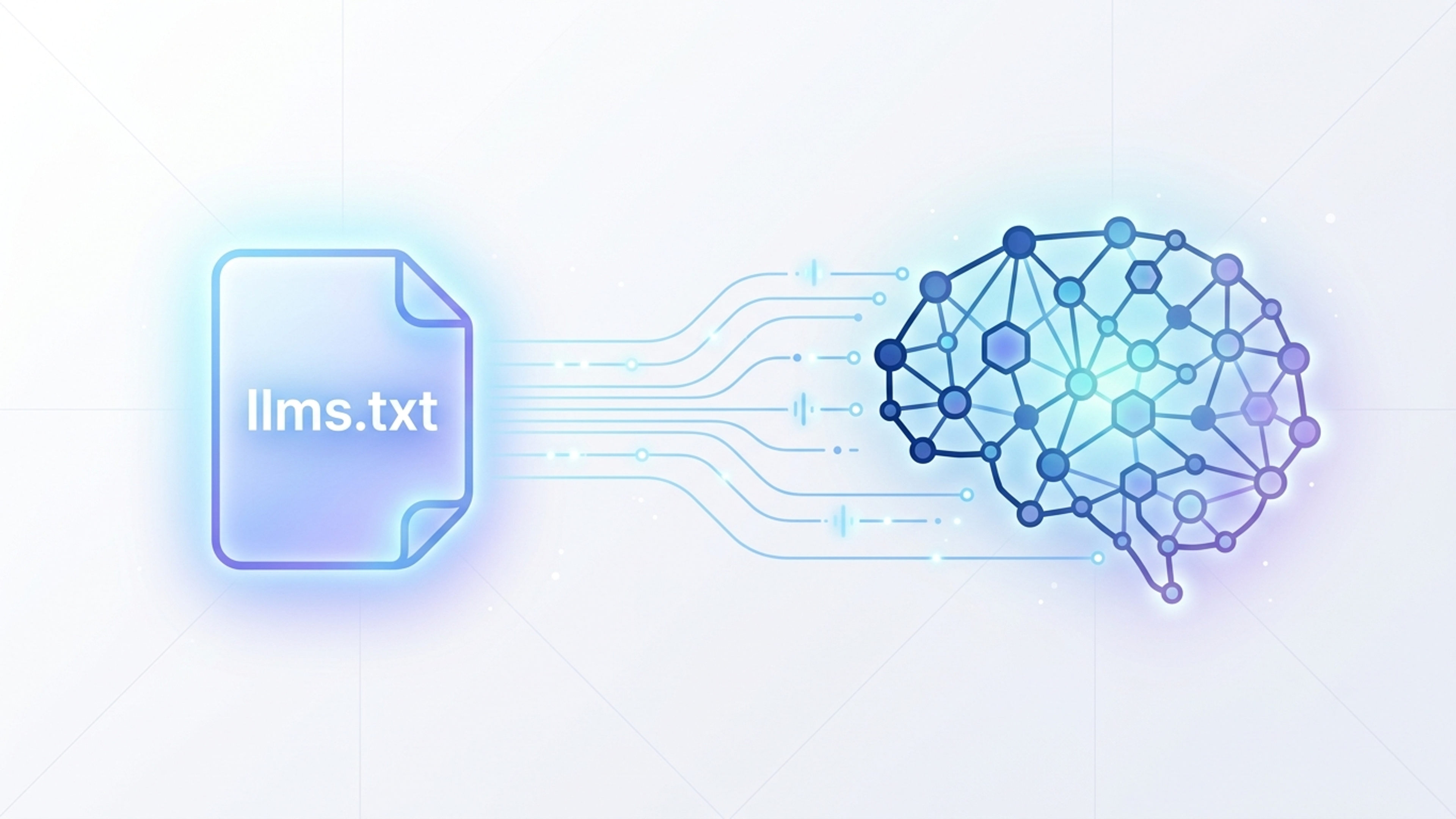
If you follow SEO news, you've probably seen llms.txt described as the must-have file for getting your business cited by ChatGPT, Perplexity, and Google's AI answers. You may also have seen it called a useless gimmick that no AI even reads. Both camps are loud, and both are partly wrong. This is the honest version: what llms.txt and llms-full.txt actually are, who really uses them in 2026, and whether a Dominican business should spend any time on them.
The short answer up front: it's a low-cost, low-risk file that is not the AI-ranking lever it's often sold as — but can be worth adding anyway, for reasons that have little to do with search rankings.
llms.txt is a proposed standard, introduced in September 2024 by Jeremy Howard of Answer.AI and documented at llmstxt.org. It's a plain Markdown file you place at the root of your domain — https://yoursite.com/llms.txt — that gives large language models a clean, curated map of your most important content, with a one-line description of each link. The first line is an H1 with your site or business name, followed by a short summary and a tidy list of your key pages.
The problem it's meant to solve is real. When an AI model reads a web page, it has a limited "context window" — it can only take in so much text at once. A normal HTML page is cluttered with navigation, ads, cookie banners, and JavaScript that waste that budget and bury the actual content. A Markdown file strips all of that away and hands the model exactly what matters, in the format it parses most efficiently.
llms-full.txt is the companion file. Instead of a curated list of links, it concatenates your full content into one long Markdown document, so a model can ingest everything in a single pass without crawling page by page. The common pattern among the sites that use these files is to publish both: llms.txt as the quick index for orientation, and llms-full.txt as the deep, full-text version. Companies like Anthropic, Vercel, and the documentation host Mintlify do exactly this.
No. Google has been clear that its search systems — including its AI features — do not use llms.txt. Google's John Mueller likened it to the old keywords meta tag: something a site owner claims about themselves that the crawler can already get from the page itself.
In June 2026, Google updated its guidance to soften the tone without changing the substance. The updated Search Central note now says, in plain terms, that it's perfectly fine to create and maintain these files for other services or systems that use them — but that doing so will neither help nor hurt your visibility in Google Search, because Google Search ignores them. So if your goal is ranking in Google or its AI Overviews, llms.txt does nothing.
This is where the marketing and the measurements part ways. Multiple server-log studies have found that the major AI search and answer crawlers — GPTBot, ClaudeBot, PerplexityBot, Google-Extended — barely touch the file. One 90-day analysis by OtterlyAI recorded tens of thousands of AI-bot visits and found only a fraction of a percent went to llms.txt. Adoption is modest too: a SE Ranking study of around 300,000 domains found roughly one in ten sites had the file, and found no measurable link between having it and being cited more often in AI answers.
So who does use it? Developer tools. AI coding assistants like Cursor and Claude Code, and some agent integrations, fetch llms.txt when a developer points them at a site's documentation. That's why the sites that publish it are overwhelmingly software and API companies — Stripe, Anthropic, Vercel, Cloudflare — whose users are building with AI assistants right now. It's a developer-experience feature far more than a marketing one.
For most local businesses today, honestly, it's optional and low-priority. If your customers aren't loading your site into a coding assistant, the immediate payoff is close to zero, and no amount of llms.txt will get you cited in ChatGPT if the fundamentals below aren't in place.
That said, there are two reasons it can still be worth adding. First, the cost and risk are near zero — especially if it's generated automatically (more on that below), so it's cheap insurance as the standard evolves. Second, the more interesting case for the future is agentic commerce: as AI agents start doing real tasks for people — "find me a dive shop in Punta Cana with availability next Tuesday" or "book a wedding venue under this budget" — a clean, machine-readable summary of your tours, prices, and policies is exactly the kind of surface those agents will route on. For a tourism or hospitality business, that's a plausible edge worth positioning for early, even if it isn't paying off this quarter.
If the real goal is to be found and cited by AI, put your effort here first — these are what the evidence consistently shows matter:
llms.txt to do; we explain it in what robots.txt is and how it can block Google.Here's the practical part. On a modern stack, llms.txt and llms-full.txt are nearly free to add. A Next.js site with a headless CMS like Sanity can generate both files automatically at build time, pulled straight from your real content — the same way it already generates your XML sitemap. When you publish a new tour or page, the files update themselves, so they never go stale. That's a very different proposition from a template site, where adding and maintaining one is manual work nobody ends up doing — one more example of why a modern build beats a template.
A few pitfalls to avoid if you do add one: don't just dump every URL on your site into it like a second sitemap; write a short, honest description for each key link; keep it current; and don't let an llms-full.txt balloon so large it overwhelms the very context window it's supposed to help.
The bottom line: llms.txt is a genuine, sensible little standard — just not a magic ranking trick. Get the fundamentals right first, then add it as cheap, automated, forward-looking optionality.
If you want your Dominican business set up properly for both search engines and AI — fast, bilingual, with the right files generated automatically — get in touch for a free consultation. We'll focus your effort on what actually moves the needle.